
What Crystals Older Than the Sun Reveal About the Start of the Solar System
Microscopic crystals extracted from meteorites could help settle a debate about the birth of our patch of the Milky Way. The post What Crystals Older Than the Sun Reveal About the Start of the Solar System first appeared on Quanta Magazine
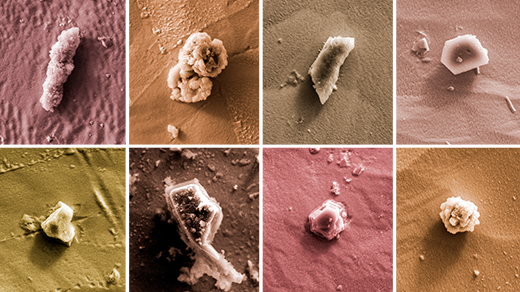
Microscopic crystals extracted from meteorites could help settle a debate about the birth of our patch of the Milky Way. These ancient crystals, older than the sun itself, hold clues to the conditions that existed during the early stages of the solar system's formation. Scientists have long relied on models and simulations to understand how our solar system came into being, but the discovery of these crystalline inclusions in meteorites offers a unique opportunity to study the raw materials of the early universe.
The standard story of the origin of our solar system has gone like this: 4.6 billion years ago, a giant cloud of dust hung frozen in space. This cloud, known as a molecular cloud, was composed mainly of hydrogen and helium, with traces of heavier elements. Over time, the cloud began to collapse under its own gravity, drawing material toward its center. As the collapse continued, the cloud fragmented into smaller clumps, each destined to become a star and its surrounding planetary system.
The collapse of the cloud was thought to have been triggered by an external event, such as the explosion of a nearby supernova. The shockwave from the explosion would have compressed parts of the cloud, initiating the gravitational collapse. As the cloud contracted, it began to spin faster due to the conservation of angular momentum, forming a rotating disk of gas and dust around the central protostar. This disk would eventually give birth to the planets, asteroids, and comets that make up our solar system.
However, this narrative has been challenged by recent findings. Some researchers argue that the solar system's formation might have been more complex than previously thought. One of the key pieces of evidence comes from the study of meteorites, particularly those classified as carbonaceous chondrites. These meteorites are believed to be some of the oldest materials in the solar system, dating back to the time when the first solid particles began to form.
Scientists have discovered tiny crystals within these meteorites that are thought to be remnants of the early solar system. These crystals, which include minerals like olivine and pyroxene, formed in the high-temperature environments of protoplanetary disks. By analyzing the composition and structure of these crystals, researchers can infer the conditions that existed during the early stages of the solar system's formation.
One of the most intriguing aspects of these crystals is their age. Using techniques like uranium-lead dating, scientists have determined that some of these crystals are older than the sun itself, suggesting that they formed in the remnants of a previous generation of stars. This finding challenges the traditional view that the solar system formed from a pristine cloud of gas and dust. Instead, it suggests that the materials that gave rise to our sun and planets may have been enriched by the debris from earlier stars.
Moreover, the study of these crystals has led to new questions about the solar system's formation. For instance, the presence of certain isotopic ratios in the crystals indicates that they formed in a region of the protoplanetary disk that was rich in heavy elements. This could imply that the solar system's formation was influenced by the presence of a nearby massive star, which would have dispersed heavy elements into the surrounding environment.
Furthermore, the crystals provide insights into the early stages of planetary formation. The study of their growth patterns and mineralogy can help scientists understand how the first solid bodies in the solar system came together to form the planets. This, in turn, can shed light on the processes that shaped the early solar system and the conditions that allowed life to emerge on Earth.
In conclusion, the discovery of microscopic crystals in meteorites older than the sun has opened up new avenues for understanding the birth of our solar system. These crystals not only challenge the traditional narrative of the solar system's formation but also offer a window into the complex interplay of factors that shaped the early universe. As researchers continue to study these ancient materials, they may uncover further clues about the origins of our solar system and the broader context of cosmic evolution. The study of these crystals underscores the power of looking back to the past to illuminate our understanding of the present and the future.









