
Vesalius, the book, and the fabric of the body
.
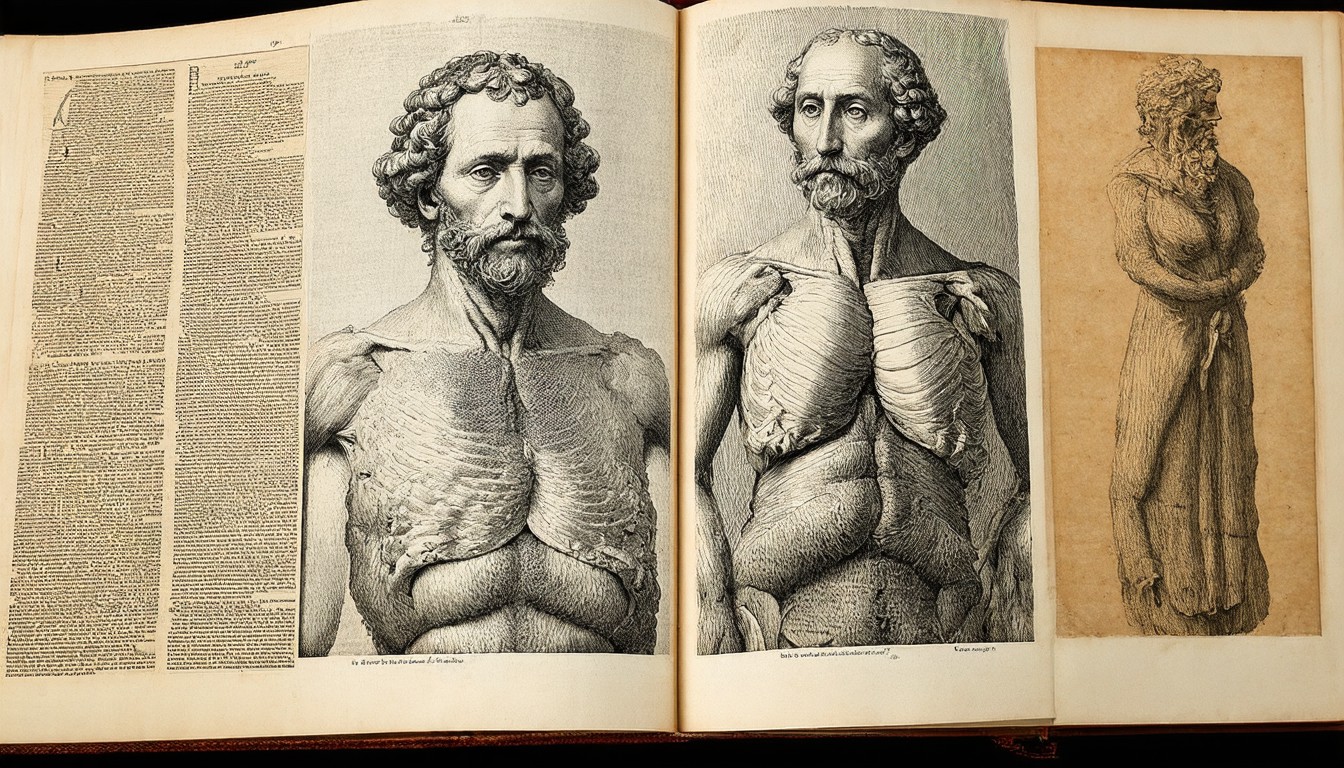
In the annals of medical history, few works have had as profound an impact as Andreas Vesalius's "De humani corporis fabrica" (On the Fabric of the Human Body). Published in 1543, this groundbreaking anatomical text not only revolutionized the understanding of human anatomy but also transformed the way medical knowledge was disseminated and studied. The book's intricate illustrations, meticulous descriptions, and departure from centuries of scholarly misconceptions marked a turning point in the scientific study of the human body.
Andreas Vesalius, a Flemish anatomist and physician, was born in 1514 in Sint-Niklaas, then part of the Habsburg Netherlands. He studied at the University of Paris and later at the University of Padua in Italy, where he became deeply disillusioned with the prevailing teachings of Galen, the ancient Greek physician whose works had dominated medical education for over a millennium. Galen's anatomical descriptions, based on animal dissections, were riddled with inaccuracies that had been perpetuated by generations of scholars. Vesalius resolved to correct these errors by conducting his own thorough dissections of human cadavers, thereby laying the foundation for his monumental work.
"De humani corporis fabrica" was a revolutionary publication in several respects. Firstly, it was the first anatomical text to be illustrated with detailed engravings based on direct human observation. The illustrations, created by skilled artists like Titian's pupil, Jan Stefan van Calcar, were meticulously accurate and often depicted the human body in innovative, dynamic poses. These images not only aided in the understanding of anatomical structures but also captured the beauty and complexity of the human form, a departure from the clinical, dispassionate approach of previous works.
Secondly, Vesalius's book challenged the authority of Galen and other ancient scholars. By grounding his descriptions in empirical observation, Vesalius demonstrated that many of Galen's claims were incorrect. For instance, he corrected the misconception that the human heart had three chambers, not four, and accurately described the structure of the ear and the skeletal system. This emphasis on observation and experimentation marked a shift towards a more scientific approach to medicine.
The publication of "De humani corporis fabrica" also ushered in a new era of medical education. Prior to its release, anatomical studies were often conducted in secret due to the Church's prohibitions on dissecting human bodies. Vesalius, however, advocated for open and public dissections, encouraging a more collaborative and inquisitive environment for medical students and practitioners. This openness not only advanced anatomical knowledge but also fostered a culture of critical thinking and innovation in the field of medicine.
The book's influence extended beyond the realm of anatomy. It played a significant role in the broader scientific revolution of the 16th and 17th centuries, inspiring thinkers like William Harvey, who later discovered the circulation of blood, and Charles Darwin, who drew upon anatomical principles in his studies of evolution. Moreover, the "Fabrica" became a cultural touchstone, with its illustrations influencing the art and literature of the time.
Despite its groundbreaking nature, Vesalius's work faced its share of challenges. The Church, wary of the potential for heresy in the study of human anatomy, initially viewed the book with suspicion. However, the "Fabrica" ultimately gained widespread acceptance and was reprinted multiple times within a few years of its initial publication. By the 17th century, it had been translated into several languages, further solidifying its place in the annals of medical history.
In conclusion, Andreas Vesalius's "De humani corporis fabrica" remains a seminal work that reshaped the understanding of the human body and the practice of medicine. Its emphasis on empirical observation, innovative illustrations, and challenge to established authority paved the way for a more scientific and accurate approach to anatomy and medicine. The book's enduring legacy serves as a testament to the power of inquiry, observation, and the pursuit of knowledge in the face of entrenched tradition. As we continue to study and understand the human body, Vesalius's work remains a cornerstone of medical education and a powerful reminder of the transformative potential of human curiosity.








