
Home TechnologyToo many cooks, or too many robots? Finding a Gold...
Technology⭐ Featured

Too many cooks, or too many robots? Finding a Goldilocks level of randomness to keep robot swarms moving

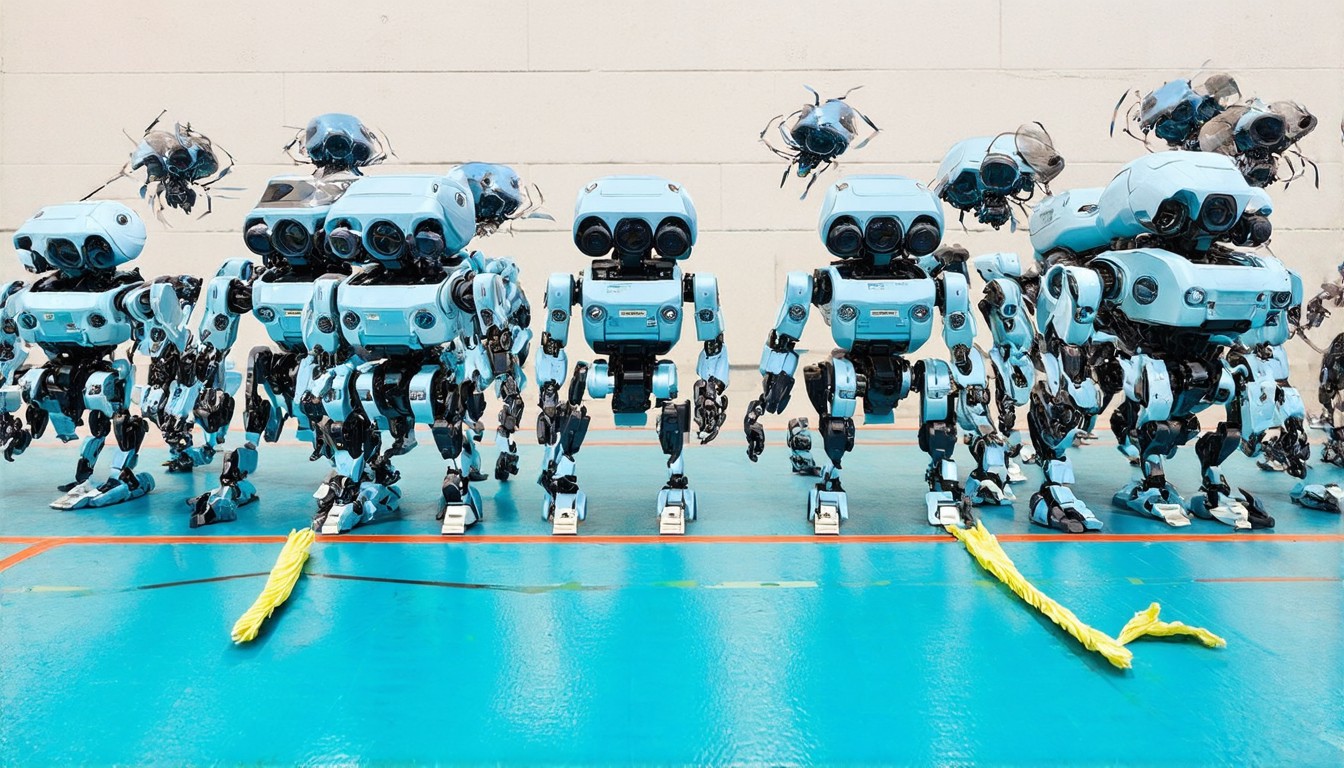
Picture a futuristic swarm of robots deployed on a time-sensitive task, like cleaning up an oil spill or assembling a machine. At first, adding robots is advantageous, since many hands make light work. But a tipping point comes when too many crowd the space, getting in each other's way and slowing the whole task down.
7 April 2026 at 08:22 am
1 views
Too many cooks, or too many robots? Finding a Goldilocks level of randomness to keep robot swarms moving

In recent years, the concept of robot swarms has captivated researchers and engineers alike, promising to revolutionize industries from disaster response to manufacturing. These swarms, composed of numerous small, autonomous robots, are designed to work collectively on complex tasks, often in environments that are too dangerous or inaccessible for human intervention. However, as these swarms grow in complexity and scale, a critical challenge emerges: finding the optimal balance between the number of robots and their randomness to ensure efficient and effective operation.

The initial intuition behind deploying more robots is straightforward—more robots mean more hands on deck to complete the task faster. This principle is well-established in human teams, where adding more members can significantly accelerate productivity. In the context of robot swarms, this advantage is amplified by the robots' ability to operate continuously without fatigue or distraction.

However, as the number of robots increases, a counterintuitive phenomenon begins to unfold. Beyond a certain threshold, the swarm's efficiency starts to decline. The robots, designed to navigate and collaborate autonomously, inadvertently create a chaotic environment as they jostle for space and resources. This congestion leads to increased collision rates, longer pathfinding times, and reduced overall throughput.

This tipping point, where the benefits of adding more robots are outweighed by the drawbacks of their increased density, highlights the need for a Goldilocks level of randomness within the swarm. Randomness, in this context, refers to the degree of unpredictability in the robots' movements and interactions. Too little randomness can result in rigid, predictable patterns that fail to adapt to changing conditions, while too much randomness can lead to the aforementioned inefficiencies.

Researchers have begun to explore the intricate relationship between randomness and swarm performance. One approach involves introducing controlled levels of randomness into the robots' decision-making processes. By incorporating stochastic elements, such as probabilistic path planning or adaptive communication protocols, the swarm can maintain flexibility and responsiveness without succumbing to the chaos of excessive randomness.

Another strategy focuses on optimizing the swarm's density. By dynamically adjusting the number of robots based on the task's demands and the environment's constraints, it is possible to avoid the pitfalls of both under- and over-saturation. This adaptive approach requires sophisticated sensing and control mechanisms, but it offers a promising path toward achieving optimal swarm performance.

The quest for the Goldilocks level of randomness is not only a technical challenge but also has broader implications for the future of robotics and artificial intelligence. As swarm technologies continue to evolve, the ability to manage complexity and adapt to dynamic environments will become increasingly critical. Understanding the interplay between randomness and efficiency in robot swarms can inform the design of more intelligent, resilient, and effective systems, ultimately paving the way for their widespread adoption in both civilian and military applications.

In conclusion, the challenge of balancing the number of robots and their randomness in swarm systems is a complex one that requires careful consideration of both theoretical principles and practical constraints. By harnessing the power of controlled randomness and adaptive density management, researchers and engineers are working to unlock the full potential of these remarkable technologies. As we navigate this frontier, the Goldilocks zone of swarm robotics beckons—a sweet spot where efficiency meets adaptability, and innovation thrives.


šŸ“° Related News
Ekaya Banaras Founder Palak Shah’s ₹40 Lakh Billboard Mistake Became a Masterclass in Startup Marketing
Ekaya Banaras founder Palak Shah recently opened up about one of the most expensive mistakes she made while building her luxury textile brand. During the early years of the company, Shah rented a premium billboard near Delhi’s DLF Emporio to increase brand visibility. However, after forgetting to cancel the campaign, the hoarding reportedly continued running for months — resulting in losses of nearly ₹40 lakh. The incident has now become a viral example of how small operational oversights can turn into costly business lessons for startups and entrepreneurs.
28 May
Betting On AI: Jensen Huang And NVIDIA’s Rise To The Top
Before AI was inevitable, it was a gamble—and Jensen Huang went all in.
14 Apr
Red Hat OpenShift sandboxed containers 1.12 and Red Hat build of Trustee 1.1 bring confidential computing to bare metal and AI workloads
Red Hat is excited to announce the release of Red Hat OpenShift sandboxed containers 1.12 and Red Hat build of Trustee 1.1, marking a major leap forward in our confidential computing journey. These releases graduate confidential containers on bare metal from …
14 Apr
Large AI firms hoovering maximum funding, not enough for smaller startups: Y Combinator’s Ankit Gupta
YC Startup School: India’s talent pool across colleges and universities are key for building next-gen startups, which is what YC is looking to tap into. It wants to target entrepreneurs building for global markets, focussed on fintech, consumer, B2B, and ecom…
14 Apr
TSMC likely to book fourth straight quarter of record profit onĀ insatiable AI demand
TSMC-RESULTS/ (PREVIEW, PIX):PREVIEW-TSMC likely to book fourth straight quarter of record profit onĀ insatiable AI demand
14 Apr
TSMC likely to book fourth straight quarter of record profit onĀ insatiable AI demand
Any profit result ā€Œabove T$505.7 billion would mark the company's highest-ever quarterly net income ​and its ninth consecutive quarter of profit growth
14 Apr
TSMC likely to book fourth straight quarter of record profit on insatiable AI demand
On Thursday, ​TSMC is expected to report a net profit of $17.1 billion for the quarter, according to an LSEG SmartEstimate compiled from 19 analysts. The war in the Middle East threatens to disrupt the supply of production materials for semiconductors such as…
14 Apr
If we can’t kick the habit, how do we manage AI’s energy needs?
One can only hope that OpenAI’s Sam Altman was joking when he sought to justify the immense energy consumption of artificial intelligence
14 Apr
What caused Nvidia Blackwell GPU prices to spike? #tech
Blackwell GPU hourly ā€œrentā€ surges on agentic AI demand A compute pricing index tracking hourly costs for Nvidia Blackwell GPUs shows a sharp climb: hourly rental hit $4.08 , up 48% from $2.75 just two months earlier. The reported driver is rising demand tied…
14 Apr
Anthropic Releases Claude Mythos Preview with Cybersecurity Capabilities but Withholds Public Access
Anthropic has introduced Claude Mythos Preview, its most advanced AI model, improving significantly in reasoning, coding, and cybersecurity. Unlike previous releases, it will not be publicly available. Access is limited to a consortium of tech companies throu…
14 Apr







