
Think Your Crypto Is Liquid? Korea’s New Asset‑Matching Regime Says Think Again
South Korea’s Financial Services Commission (FSC) is ordering all domestic crypto exchanges to implement near real‑time asset‑matching systems. A Tighter Time-Regime For Crypto Exchanges All Korean crypto exchanges must have a new asset-matching system by the end of May if they don’t want compliance problems, the financial regulator said this Monday. According to The Korea […]
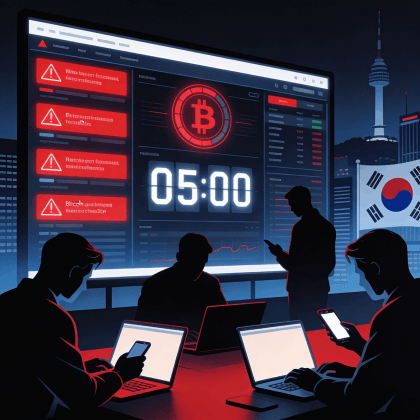
South Korea’s Financial Services Commission (FSC) has recently imposed a stringent new requirement on domestic crypto exchanges, demanding that they implement near real-time asset-matching systems by the end of May. This move comes as part of a broader effort to tighten regulatory controls over the virtual asset market in the country.
The FSC’s decision mandates that all Korean crypto exchanges switch from their current 24-hour reconciliation cycles to a uniform 5-minute asset-matching regime. A time asset-matching system is a software that continuously compares the balances and positions reported on an exchange’s internal ledger with the actual cryptocurrencies and fiat money stored in wallets and bank accounts. In real-time asset tracking, the system reconciles user balances, order-book positions, and margin against on-chain and off-chain reserves every few minutes. If a discrepancy exceeds a predetermined threshold, the system can automatically trigger alerts or even a kill-switch to halt deposits, withdrawals, or trading activities.
Regulators have identified flaws in the existing kill-switch mechanisms of some major exchanges, particularly during significant mismatches. To address this, the FSC is also requiring exchanges to report their asset-matching results on a daily basis, with additional independent reviews conducted by accounting firms every month. This ensures greater transparency and accountability in the market.
This latest regulatory update represents the most aggressive tightening of operational rules since Korea’s initial wave of virtual-asset laws. The connected regulations will be integrated into a new bill aimed at governing the broader virtual asset market, known as the Digital Asset Basic Act. The government and the ruling Democratic Party are currently refining the virtual-asset legislation’s phase 2, according to The Korea Times. The Framework Act on Digital Assets was initially scheduled to be discussed on the National Policy Committee’s March 31st agenda, but the debate on the crypto act’s second phase has been postponed until after the June 3 local elections.
The FSC’s decision to enforce real-time asset-matching systems highlights the growing focus on ensuring the stability and security of the crypto market in South Korea. By implementing these stringent measures, the regulator aims to prevent fraudulent activities and protect consumer interests. The move also underscores the evolving landscape of digital asset regulation, as governments worldwide grapple with the challenges posed by the rapid growth of cryptocurrencies and decentralized finance.
In the context of global crypto regulations, South Korea’s new asset-matching regime stands as a significant development. It not only imposes stricter operational standards on domestic exchanges but also serves as a model for other jurisdictions considering similar measures. The FSC’s proactive approach to regulating the crypto sector is expected to have a ripple effect on the industry, influencing the way digital assets are managed and traded across borders.
As the deadline for compliance approaches, Korean crypto exchanges must adapt quickly to avoid potential regulatory penalties. This transition period will likely test the resilience and adaptability of the local crypto industry, with exchanges scrambling to implement the necessary technological infrastructure. The successful implementation of real-time asset-matching systems will be crucial in maintaining the trust and confidence of investors and users in the Korean crypto ecosystem.
In conclusion, South Korea’s Financial Services Commission’s decision to enforce near real-time asset-matching systems on domestic crypto exchanges marks a significant escalation in regulatory control. This move, coupled with the ongoing refinement of the Digital Asset Basic Act, underscores the government’s commitment to safeguarding the virtual asset market and ensuring transparency and accountability. As the crypto industry continues to evolve, South Korea’s regulatory framework will serve as a benchmark for other nations navigating the complexities of digital asset regulation.








