The Week in 5 Charts: Escalating Fuel Costs, Demographic Shifts, Global Health Alerts, and Historic Tech IPOs
Over the past week, in what seems to be a continuing trend, fuel prices across the country were hiked twice across all variants; the SRS bulletin report showed positive performance of the country in key indicators, and Ebola cases surged again. Here are the top developments throughout last week in graphics and charts.
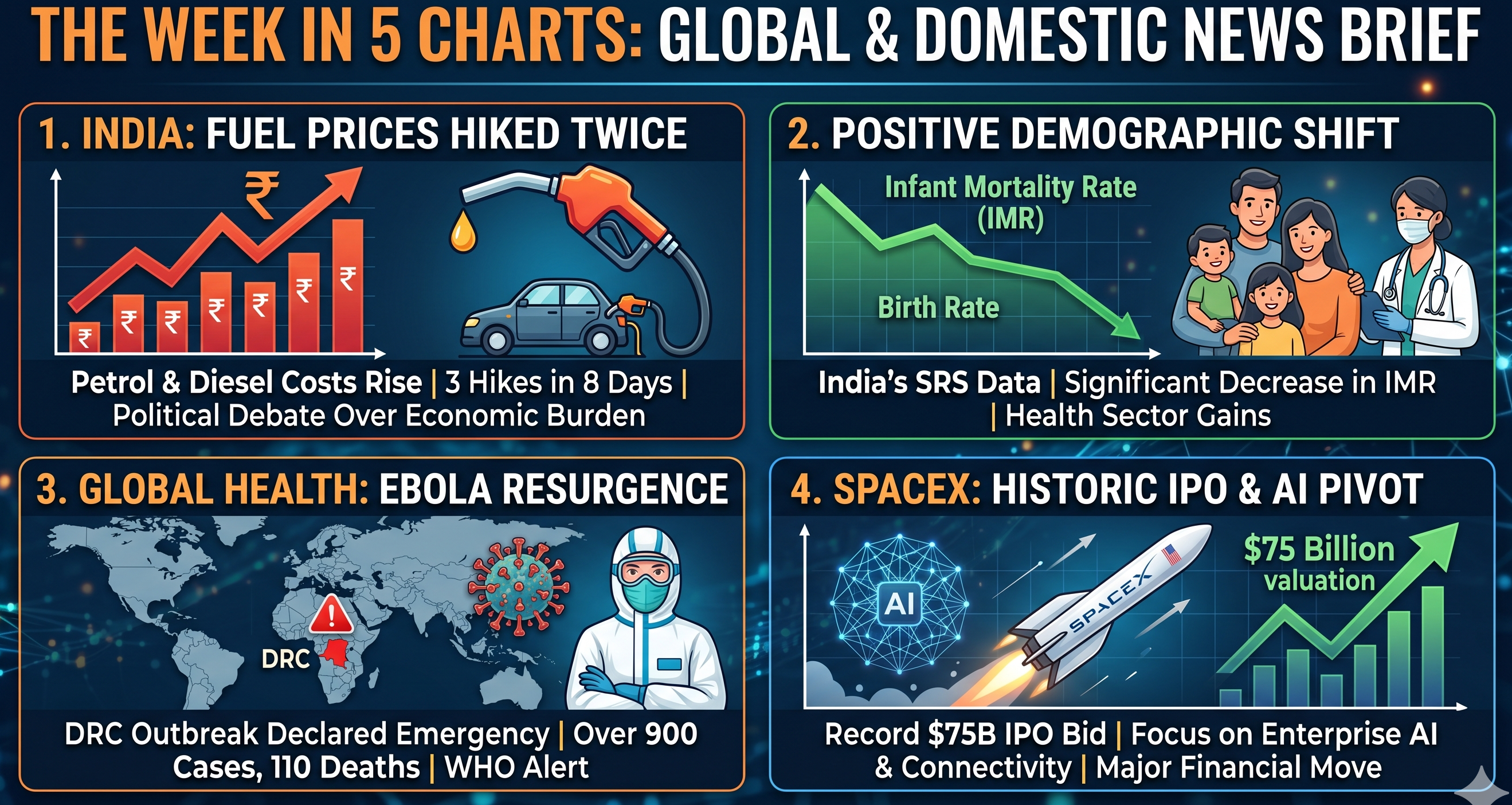
This week’s key developments span multiple sectors, from domestic economic burdens and demographic shifts in India to global health emergencies and monumental moves in the corporate space sector. Visualized through crucial data charts, the overarching narratives focus on escalating fuel prices, encouraging demographic transitions, a troubling Ebola resurgence, and SpaceX’s historic Initial Public Offering (IPO).
1. Domestic Fuel Prices See a Sharp Upward Trajectory
After a prolonged period of relative stagnation, retail fuel prices in India have experienced a sudden and steep rise. Over the past week, fuel prices were hiked twice—specifically on May 19 and May 23—marking the third increase in a mere eight-day window. On May 23 alone, prices for both petrol and diesel variants were raised by an average of 90 paise per litre nationwide.
Cumulatively, since the initial hike on May 15, the retail prices of diesel and petrol have increased by approximately ₹4.8 per litre across three separate tranches. Data charts mapping the retail selling prices in major metropolitan cities (Delhi, Mumbai, Chennai, and Kolkata) illustrate that aside from minor regional variations, fuel rates had remained largely static from March 2024 until this mid-May surge. This sudden spike has prompted widespread political debate, with opposition parties criticizing the central government over the rising financial burden on everyday citizens.
2. India’s Positive Demographic Transition
The newly released Sample Registration System (SRS) 2024 bulletin sheds light on a significant demographic transition occurring across India, capturing a decade of vital statistics. The data highlights a remarkable improvement in key national demographic indicators.
The national birth rate—measured as live births per 1,000 population—has seen a steep decline from 21 in 2014 to 18.3 in 2024. Simultaneously, the death rate has marginally decreased from 6.7 to 6.4 per 1,000 people. Most notably, the Infant Mortality Rate (IMR) has dramatically fallen from 39 to 24 deaths per thousand live births over the same period. While the overall national performance reflects positively on various health interventions launched by state and central governments, the data reveals stark regional and geographical disparities. Urban areas have seen the most appreciable gains, particularly concerning IMR, leaving rural areas lagging. Furthermore, southern states like Kerala and Tamil Nadu continue to significantly outperform the rest of the country across all these health metrics.
3. Resurgence of Ebola in Central Africa
On the global health front, an alarming surge in Ebola cases has been reported in the Democratic Republic of Congo (DRC). By May 25, 2026, cases had crossed the 900 mark, with the death toll exceeding 110. In response to the rapidly escalating crisis, the World Health Organization (WHO) officially declared the outbreak a national emergency on May 17.
This declaration followed an earlier alert by the Africa Centre for Disease Control and Prevention regarding an outbreak in Congo's Ituri province that had previously claimed 65 lives. The data visualization of historical Ebola outbreaks since 1976 underscores the severity of the current situation. This year’s outbreak is now the third highest in recorded history in terms of cases. While it still trails the devastating 2014 West African epidemic—which saw over 28,000 cases and 11,000 deaths—the rapid spread highlights ongoing challenges in market failures regarding vaccine research and global health infrastructure. To date, no cases have been reported in India.
4. SpaceX’s Massive $75 Billion IPO and AI Pivot
In the corporate sphere, Elon Musk’s SpaceX has dominated headlines by releasing its prospectus on May 20 ahead of its highly anticipated IPO. The company is targeting a colossal raise of $75 billion, which would mark the largest IPO bid in U.S. market history. Surprisingly, the prospectus reveals a massive pivot towards Artificial Intelligence.
SpaceX has identified a "Total Addressable Market" (TAM) of $28.5 trillion, classifying it as the largest in human history. A staggering $22.7 trillion of this is projected to come from the enterprise AI segment, heavily overshadowing traditional space connectivity. This strategic shift is reflected in the company’s capital expenditure: for the year ending 2025, AI received $12.7 million out of a total $20.7 million in CapEx. However, financial charts indicate that AI currently operates at a loss, with the segment recording an operational loss of $2.4 million in Q1 2026, compared to a $662 million loss in the space segment. Despite these current shortfalls, SpaceX is betting aggressively that its AI and connectivity segments will be primary growth drivers, ultimately generating the revenue needed to fund a robust lunar economy and Martian colonization.