The depths of Neptune and Uranus may be 'superionic'
The interiors of ice giant planets like Uranus and Neptune could be home to a previously unknown state of matter, according to new computational simulations by Carnegie's Cong Liu and Ronald Cohen. Their work, published in Nature Communications, predicts that a quasi-one-dimensional superionic state of carbon hydride exists under the extreme pressures and temperatures found deep inside these outer solar system bodies.
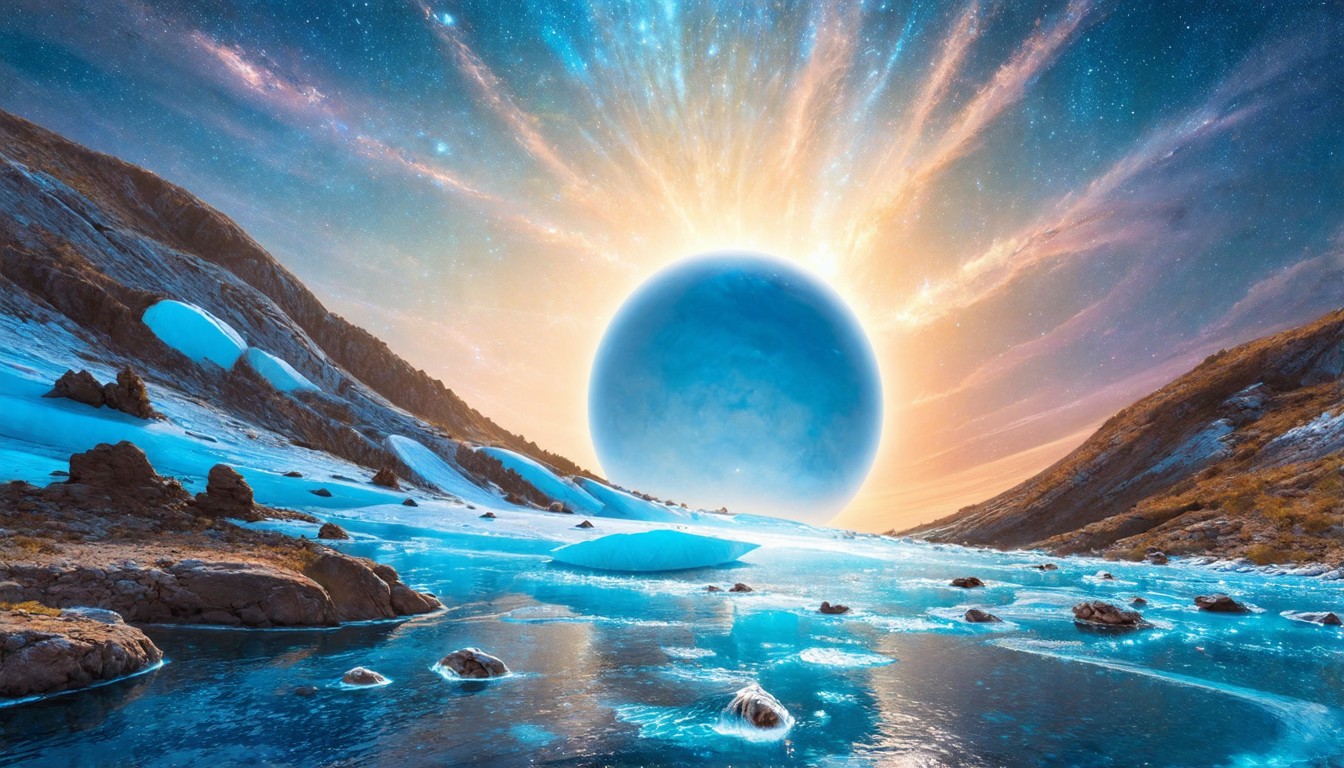
In a groundbreaking study published in Nature Communications, researchers Cong Liu and Ronald Cohen from Carnegie Institution for Science have unveiled a previously unknown state of matter that may exist deep within the interiors of the ice giant planets Uranus and Neptune. This discovery, which challenges our understanding of planetary structure, suggests that these distant outer solar system bodies might harbor a quasi-one-dimensional superionic state of carbon hydride under the extreme pressures and temperatures found at their cores.
The ice giants Uranus and Neptune, known for their unique compositions and rapid rotation, have long puzzled astronomers. Unlike the gas giants Jupiter and Saturn, which are primarily composed of hydrogen and helium, Uranus and Neptune are rich in ices such as water, ammonia, and methane. These icy compositions, combined with the immense pressures at their cores, have led scientists to speculate about the possible states of matter that might exist beneath their surfaces.
Liu and Cohen's computational simulations, which model the extreme conditions within these planets, predict the existence of a superionic state. A superionic state is a phase of matter where a lattice of ions is embedded in a sea of free electrons, akin to a solid with a liquid electron component. This state is typically found in the interiors of planets and stars, where immense pressures and temperatures prevent conventional molecular structures from forming.
The researchers' focus on carbon hydride, a compound of carbon and hydrogen, is particularly intriguing. Carbon hydride, under normal conditions, is a gas, but under the extreme pressures of a planetary core, it is hypothesized to form a superionic state. This quasi-one-dimensional arrangement implies that the carbon and hydrogen atoms are arranged in a linear structure, with electrons flowing freely between them. Such a state would be highly conductive and could potentially play a significant role in the thermal and electrical properties of these planets.
The implications of this discovery are profound. If confirmed, the presence of a superionic state in Uranus and Neptune would not only deepen our understanding of planetary interiors but also expand our knowledge of exotic states of matter. It could also provide insights into the formation and evolution of these unique planets, as well as other icy bodies in the solar system, such as the moons of Jupiter and Saturn.
Moreover, this research highlights the power of computational simulations in exploring the extreme conditions found within planetary cores. By modeling these environments, scientists can make predictions about the possible states of matter that might exist, even if direct observation is currently beyond our technological capabilities.
As the authors continue to refine their models and explore the potential implications of their findings, the scientific community is likely to engage in lively discussions about the nature of planetary interiors and the diverse states of matter that may exist in the universe. This discovery serves as a reminder of the vast frontiers of knowledge still to be uncovered, even in the study of our own solar system.
In conclusion, the work of Liu and Cohen challenges our understanding of the ice giant planets Uranus and Neptune by proposing the existence of a previously unknown superionic state of carbon hydride deep within their cores. This groundbreaking research not only advances our knowledge of planetary science but also underscores the importance of computational modeling in exploring the extreme conditions of the cosmos. As further studies are conducted, the potential for new discoveries in the depths of these enigmatic worlds continues to captivate scientists and the public alike.