
The 4 ways science confirms the Moon landings were real
With the launch of Artemis II in April of 2026, humans are finally set to add to the historical precedent set in the late 1960s and early 1970s: a return to the Moon. Prior to their expected arrival at our nearest neighboring planetary body, expected to occur after just over a four day journey, a gap of more than 50 years persisted between human visits to the Moon. During the Apollo era, only 24 people ever flew to the vicinity of the Moon, traveling hundreds of thousands of miles from Earth to do so. Twelve of those travelers, on six independent missions, actually set foot on the lunar surface. Many artifacts have been left behind on the Moon during that time: flags, photographs, seismometers, mirrors, and even vehicles, while those same humans brought back rocks, dirt, and actual pieces of the Moon. (An autonomous sample return mission, from the lunar far side, was also conducted by China earlier this decade.) Of everyone still alive today, fewer than 25% are old enough to have memories of these monumental moments in history: when humanity traveled to and landed on the Moon in the late 1960s and early 1970s. Unsurprisingly, some people — most of them too young to have experienced those moments for themselves — are skeptical that the Moon landings ever happened. Thankfully, in science, we don’t need to be there ourselves to have proof. Here are four different pieces of evidence we can point to that demonstrate the Moon landings
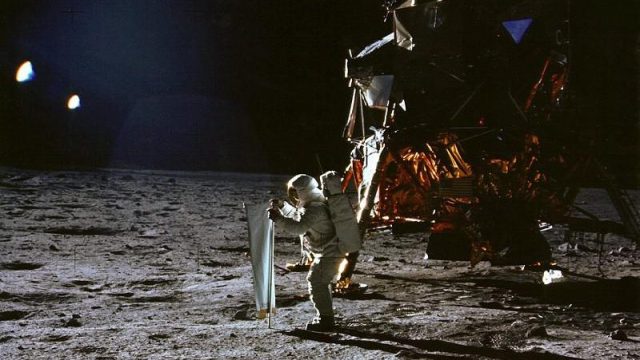
With the launch of Artemis II in April of 2026, humans are finally set to add to the historical precedent set in the late 1960s and early 1970s: a return to the Moon. Prior to their expected arrival at our nearest neighboring planetary body, expected to occur after just over a four-day journey, a gap of more than 50 years persisted between human visits to the Moon. During the Apollo era, only 24 people ever flew to the vicinity of the Moon, traveling hundreds of thousands of miles from Earth to do so. Twelve of those travelers, on six independent missions, actually set foot on the lunar surface. Many artifacts have been left behind on the Moon during that time: flags, photographs, seismometers, mirrors, and even vehicles, while those same humans brought back rocks, dirt, and actual pieces of the Moon. (An autonomous sample return mission, from the lunar far side, was also conducted by China earlier this decade.) Of everyone still alive today, fewer than 25% are old enough to have memories of these monumental moments in history: when humanity traveled to and landed on the Moon in the late 1960s and early 1970s. Unsurprisingly, some people—most of them too young to have experienced those moments for themselves—are skeptical that the Moon landings ever happened. Thankfully, in science, we don't need to be there ourselves to have proof. Here are four different pieces of evidence we can point to that demonstrate the Moon landings actually occurred.
The first piece of evidence is the presence of lunar footprints. Here on Earth, footprints generally don't last very long. Wherever you leave your tracks, you fully expect that natural phenomena or human activity will eventually erase them. However, on the Moon, the environment is vastly different. There is no wind, rain, or other weather conditions to erode or obscure footprints. This means that any footprints left by astronauts would remain preserved for eternity. These (and other) astronaut footprints are still visible from orbit around the Moon, but no Earth-based telescope can image anywhere near the necessary resolution to reveal them from the ground. The iconic image, taken by Neil Armstrong, shows Buzz Aldrin planting the US flag on the Moon. Note the presence of footprints in the foreground. This serves as a clear and irrefutable proof that humans indeed walked on the Moon.
The second piece of evidence is the presence of artifacts left behind by astronauts. During the Apollo missions, astronauts left behind a variety of items on the Moon, including flags, photographs, seismometers, mirrors, and even vehicles. These artifacts serve as tangible proof of human presence on the lunar surface. For instance, the Apollo 11 mission left behind a flagpole and the American flag, which can still be seen from orbit. Additionally, seismometers and other scientific equipment were deployed to study the Moon's seismic activity, providing valuable data that has been verified by subsequent missions. These artifacts not only confirm the presence of humans on the Moon but also demonstrate the technological capabilities of the time, which would have been necessary to achieve such a feat.
The third piece of evidence is the lunar samples brought back to Earth. Astronauts returned with rocks, dirt, and actual pieces of the Moon, which have been extensively studied by scientists worldwide. These samples have been analyzed using various techniques, including spectroscopy, microscopy, and isotopic analysis, to confirm their lunar origin. For example, the presence of certain minerals and isotopic ratios in the samples is unique to the Moon and cannot be found on Earth. These scientific analyses provide concrete evidence that the Moon landings occurred and that the samples were indeed collected from the lunar surface.
The fourth piece of evidence is the impact of the Moon landings on subsequent space exploration. The success of the Apollo program inspired a new era of space exploration, leading to advancements in technology, space science, and international cooperation. The knowledge and expertise gained from the Moon landings have been applied to numerous missions, including the development of the International Space Station, robotic exploration of other planets, and the ongoing Artemis program. The lasting impact of the Apollo missions on space exploration serves as a testament to their historical significance and the reality of the Moon landings.
In conclusion, the Moon landings were not just a series of events in history but have left a lasting impact on science, technology, and international relations. The four pieces of evidence—lunar footprints, artifacts left behind, lunar samples, and the impact on space exploration—provide a robust foundation for confirming the authenticity of the Moon landings. While skepticism may arise from those unfamiliar with the historical context, the scientific evidence is overwhelming and irrefutable. As we prepare for the return of humans to the Moon with the Artemis program, these landings remain a testament to human achievement and the boundless potential of exploration.








