
Home ScienceTerrifying New Maps Show the Entire West is Facing...
Science⭐ Featured

Terrifying New Maps Show the Entire West is Facing an Extreme Wildfire Threat This Summer

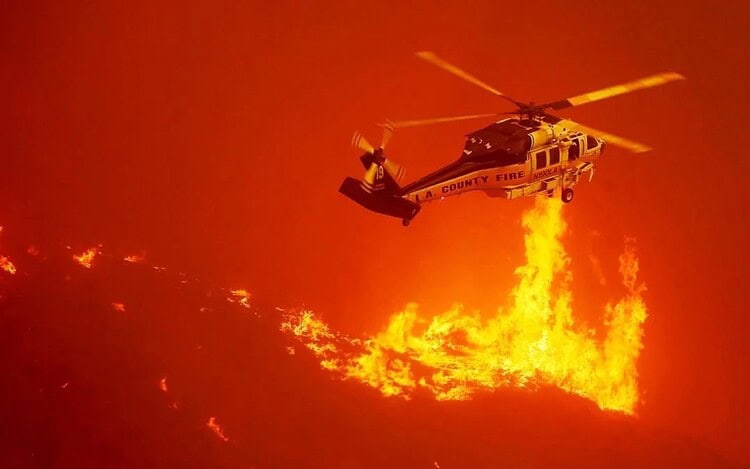
Amid drought and heat waves, April’s national wildfire forecast shows that nearly the entire Western U.S. will face an above-normal risk of wildfires at some point in the next four months.
6 April 2026 at 05:23 pm
1 views
Terrifying New Maps Show the Entire West is Facing an Extreme Wildfire Threat This Summer

As the first signs of spring begin to fade, ominous clouds of smoke and ash loom over the horizon of the Western United States. This year, the region is bracing itself for an unprecedented wildfire season, as terrifying new maps reveal that nearly the entire West is facing an extreme wildfire threat this summer. The forecast, based on the National Interagency Fire Center's April report, paints a stark picture of drought-ridden landscapes and heat waves that will ignite a wildfire storm unlike any seen in recent memory.

The Western U.S., a region already accustomed to periodic wildfires, is now facing a new level of peril. From California's rugged coastline to Wyoming's high plains, and stretching across the Rocky Mountains and the Great Basin, the threat is relentless. Experts warn that the combination of prolonged drought conditions, high temperatures, and strong winds will create a perfect storm for wildfires to ignite and spread with alarming speed.

Drought has been a persistent issue in the West for years, but this season's conditions are particularly dire. Many areas of the region are experiencing their driest start to spring in decades. In some parts of California, the Sierra Nevada snowpack is at record-low levels, a stark reminder of the impact of climate change on the region's water cycle. As temperatures continue to rise, the drying effect is exacerbated, turning once-lush forests into tinderboxes.

Heat waves are another critical factor in this summer's wildfire forecast. The Western U.S. has been hit by record-breaking temperatures in recent months, with some regions experiencing consecutive days of extreme heat. These conditions not only intensify the drought but also dry out vegetation, making it more susceptible to ignition. The combination of high temperatures and low humidity creates a volatile atmosphere that can spark wildfires with alarming ease.

Strong winds are the final piece of the wildfire puzzle. The Western U.S. is prone to gusty winds, especially during the summer months. These winds can carry embers and flames, turning small fires into massive blazes that are difficult to contain. In some cases, wildfires can spread across entire counties in a matter of hours.

The implications of this extreme wildfire threat are profound. Communities across the West are bracing for evacuations, property damage, and the potential loss of life. Firefighters are already working tirelessly to combat the growing number of blazes, but the sheer scale of this season's threats is daunting. Many experts predict that the cumulative impact of these wildfires will be felt for years to come, with long-term ecological damage and increased vulnerability to future disasters.

In addition to the immediate dangers, the broader consequences of this summer's wildfires are cause for concern. The smoke from these blazes can travel thousands of miles, affecting air quality in distant cities and contributing to health problems for vulnerable populations. The carbon emissions from wildfires are also a significant concern, as they release vast amounts of CO2 into the atmosphere, exacerbating climate change.

As the Western U.S. prepares for this extreme summer, the need for urgent action is more critical than ever. Authorities are urging residents to take precautions, such as removing flammable materials from their homes and staying informed about fire conditions. Communities are also investing in improved firefighting infrastructure and resources, but the scale of the challenge is immense.

The terrifying new maps serve as a stark reminder of the urgent need for comprehensive wildfire management strategies. Policymakers must address the root causes of these extreme conditions, including climate change and unsustainable land-use practices. Investments in conservation efforts, such as controlled burns and reforestation, are also crucial in mitigating the risks of future wildfires.

In the face of this unprecedented threat, the Western U.S. is being tested like never before. As the summer sun begins to blaze, the region's resilience will be put to the ultimate test. The stakes are high, and the challenges are formidable. But with determination, collaboration, and a renewed commitment to protecting the land and its people, the West may yet emerge stronger from this fiery ordeal.


Source: ZME Science
📰 Related News
The largest orbital compute cluster is open for business | TechCrunch
Kepler Communications is flying 40 GPUs in Earth orbit. And its latest customer is Sophia Space.
14 Apr
‘Mideast conflict poses risks to Philippines growth’
The Philippine economy is expected to grow at a faster pace of 5.3 percent this year from last year’s 4.4 percent but the ongoing Middle East conflict is seen to pose risks, according to the Association of Southeast Asian Nations Plus 3 Macroeconomic Research Office.
7 Apr
AFBI welcomes DUP representatives to its research farm at Hillsborough
The Agri-Food and Biosciences Institute (AFBI) welcomed a number of DUP representatives to its research farm at Hillsborough on Friday.
7 Apr
A simple way to get more value from metrics
We spent one day 1 building a system that immediately found a mid 7 figure optimization (which ended up shipping). In the first year, we shipped mid 8 figures per year worth of cost savings as a result. The key feature this system introduces is the ability to query metrics data across all hosts and all services and over any period of time (since inception), so we've called it LongTermMetrics (LTM) internally since I like boring, descriptive, names. This got started when I was looking for a starter project that would both help me understand the Twitter infra stack and also have some easily quantifiable value. Andy Wilcox suggested looking at JVM survivor space utilization for some large services. If you're not familiar with what survivor space is, you can think of it as a configurable, fixed-size buffer, in the JVM (at least if you use the GC algorithm that's default at Twitter). At the time, if you looked at a random large services, you'd usually find that either: The buffer was too small, resulting in poor performance, sometimes catastrophically poor when under high load. The buffer was too large, resulting in wasted memory, i.e., wasted money. But instead of looking at random services, there's no fundamental reason that we shouldn't be able to query all services and get a list of which services have room for improvement in their configuration, sorted by performance degradation or cost savings. And if we write that query for JVM survivor space, this also
7 Apr
Accelerating Mathematical and Scientific Discovery with Gemini Deep Think
Research papers point to the growing impact of Deep Think across fields
7 Apr
Gemini 3 Deep Think: Advancing science, research and engineering
Our most specialized reasoning mode is now updated to solve modern science, research and engineering challenges.
7 Apr
Context Engineering for Coding Agents
The number of options we have to configure and enrich a coding agent’s context has exploded over the past few months. Claude Code is leading the charge with innovations in this space, but other coding assistants are quickly following suit. Powerful context engineering is becoming a huge part of the developer experience of these tools. Birgitta Böckeler explains the current state of context configuration features, using Claude Code as an example. more…
7 Apr
What does less protein and nitrogen mean for methane?
Does feeding less protein to cows over a longer period not only reduce nitrogen losses, but also affect methane emissions? Researchers at Wageningen University & Research (WUR) investigated this in a multi-year study with dairy cows, funded by the Vereniging Diervoederonderzoek Nederland (VDN), the Dutch Ministry of Agriculture, Fisheries, Food Security and Nature (LVVN), and […] The post What does less protein and nitrogen mean for methane? appeared first on Agriland.ie .
7 Apr
Second’s Bark Boasts New era of Bitcoin Payments, drawing in former Blockstream developers
Bitcoin Magazine Second’s Bark Boasts New era of Bitcoin Payments, drawing in former Blockstream developers Second, the Bitcoin development lab founded by ex-Blockstream executives including CEO Steven Roose and CTO Erik De Smedt, has unveiled Bark — its custom Ark protocol implementation promising self-custodial payments that are faster and cheaper than Lightning channels. This post Second’s Bark Boasts New era of Bitcoin Payments, drawing in former Blockstream developers first appeared on Bitcoin Magazine and is written by Juan Galt .
7 Apr
'Morale boost': Nasa carries out Moon mission during tough year for science
HOUSTON — As the four Artemis astronauts approached a high point of their lunar mission -- getting slung around the far side of the Moon -- National Aeronautics and Space Administration (Nasa) staffers crowded into Houston's famed mission control room Monday for a team photo.
7 Apr






