
Researchers unveil user-friendly robotic arm in Mexico
In Guadalajara, Mexico, researchers created the E-Redi prosthetic arm, a simpler bionic limb using one muscle sensor to control multiple natural movements.
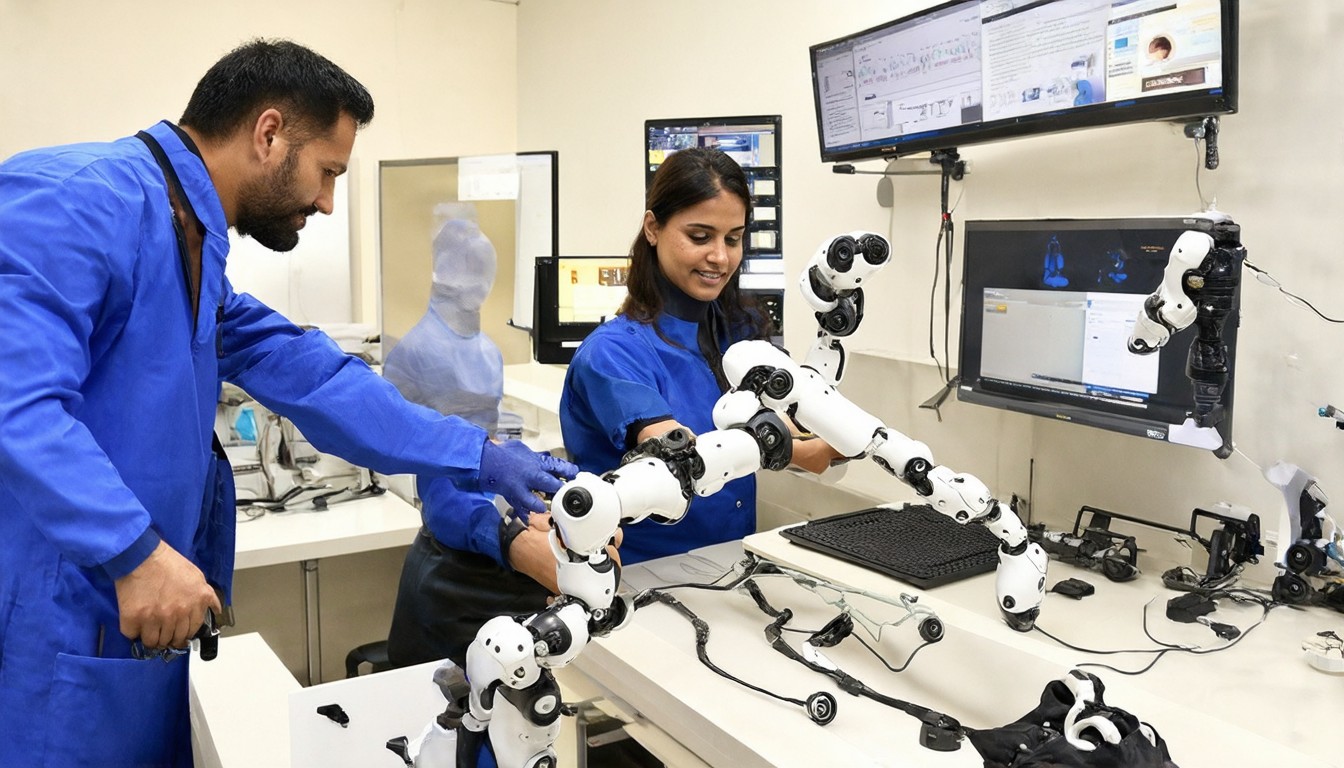
In Guadalajara, Mexico, a team of researchers has made a significant breakthrough in prosthetic technology with the development of the E-Redi prosthetic arm. This innovative device, designed to be user-friendly and accessible, has the potential to revolutionize the way amputees interact with their surroundings. The E-Redi arm stands out due to its simplicity and efficiency, utilizing just one muscle sensor to control multiple natural movements, which sets it apart from traditional prosthetic limbs that often require complex systems and multiple sensors.
The E-Redi prosthetic arm was developed by a group of researchers at the University of Guadalajara, who have been working on improving prosthetic technology for several years. The project was driven by a desire to create a more affordable and practical solution for amputees, particularly in regions where access to advanced prosthetics is limited. The team recognized that many existing prosthetics are expensive and require extensive training to use effectively, which can be a barrier for many individuals.
The key innovation of the E-Redi arm lies in its single muscle sensor, which is placed on the residual limb. This sensor detects subtle electrical signals generated by the user's muscles, allowing the prosthetic to interpret the intended movements and execute them in a natural and intuitive manner. By using just one sensor, the E-Redi arm eliminates the need for multiple sensors and complex wiring, significantly reducing the cost and complexity of the device.
The researchers behind the E-Redi arm have conducted extensive testing with amputees to ensure that the prosthetic is both functional and user-friendly. Feedback from participants has been overwhelmingly positive, with many reporting that they can perform everyday tasks with greater ease and confidence. The prosthetic's ability to mimic natural movements means that users can grasp objects, open doors, and perform other actions without the need for specialized training.
One of the most notable advantages of the E-Redi arm is its potential to democratize access to advanced prosthetic technology. By reducing costs and simplifying the design, the device could be produced in larger quantities, making it more affordable for amputees in developing countries and lower-income communities. This could lead to a significant improvement in the quality of life for millions of people worldwide who currently lack access to effective prosthetics.
The development of the E-Redi prosthetic arm is also a testament to the growing potential of Mexico as a hub for innovation in medical technology. Guadalajara, in particular, has become a focal point for research in this field, attracting talented scientists and engineers who are eager to contribute to advancements in prosthetics and other areas of healthcare.
As the E-Redi arm continues to be refined and tested, the researchers are optimistic about its potential impact on the lives of amputees. They believe that their creation could pave the way for a new generation of prosthetic limbs that are not only more accessible but also more intuitive and natural in their operation.
In conclusion, the E-Redi prosthetic arm represents a groundbreaking achievement in the field of medical robotics. By simplifying the design and reducing costs, the device offers a viable solution for amputees who currently struggle to access effective prosthetics. The success of the E-Redi arm could have far-reaching implications, not only for those directly affected by limb loss but also for the broader medical technology industry, as it demonstrates the potential for innovation and accessibility in prosthetic design.









