
Questions for the Munich hawks
It is wrong to use Neville Chamberlain as a byword for cowardice and fecklessness Source
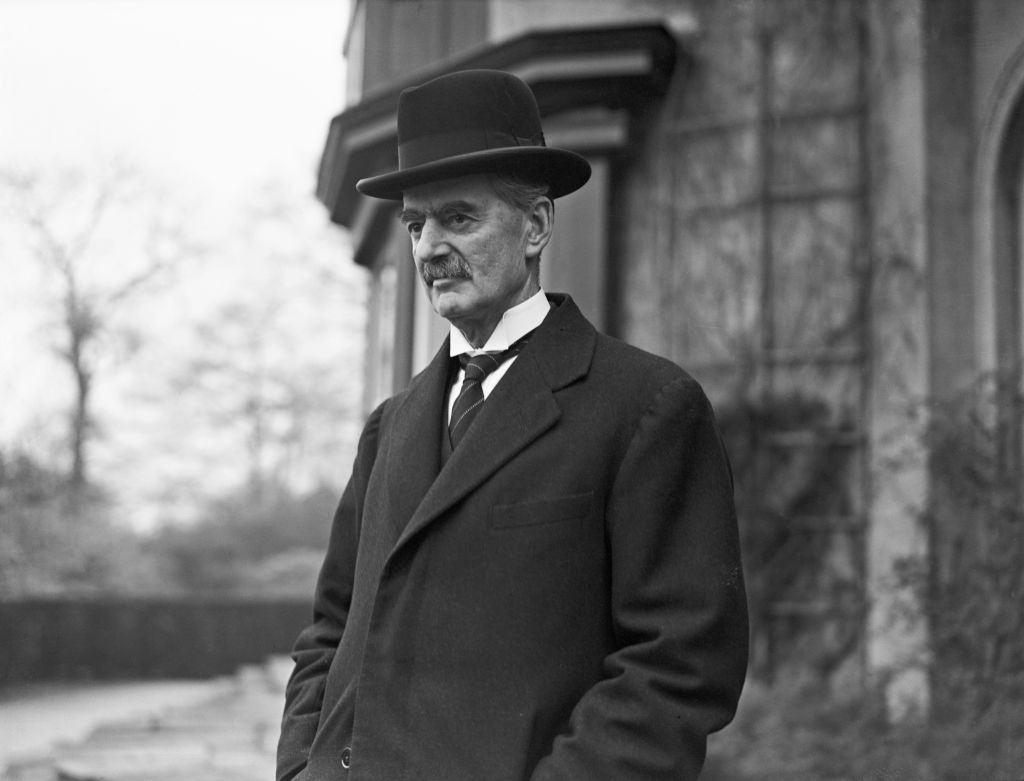
The Munich Agreement, signed in 1938, is often remembered as a symbol of appeasement and naivety, with British Prime Minister Neville Chamberlain being particularly criticized for his role in it. However, recent historians and commentators have begun to reevaluate Chamberlain's actions, arguing that he was not as reckless or cowardly as he is commonly portrayed. This reexamination of history has sparked a renewed debate about the merits of Chamberlain's approach and the broader implications for contemporary foreign policy.
Chamberlain's decision to allow Adolf Hitler to annex parts of Czechoslovakia in exchange for a promise of peace has long been seen as a misguided attempt to avoid war. The Munich Agreement, brokered by Chamberlain, Édouard Daladier of France, and Benito Mussolini of Italy, handed over the Sudetenland—a region with a large German population—to Nazi Germany. Chamberlain famously returned to Britain with a "peace for our time" speech, claiming that he had secured peace in Europe. Yet, just a year later, Germany invaded Poland, triggering World War II.
Critics of Chamberlain argue that his policy of appeasement emboldened Hitler, who saw it as a sign of weakness and proceeded to expand his territorial claims. They point to the failure of the agreement to prevent the war as evidence of Chamberlain's fecklessness. However, proponents of a more nuanced view of Chamberlain's actions contend that he was operating under significant constraints and that his intentions were not as misguided as they seem in retrospect.
One key factor in Chamberlain's decision-making was the state of British military preparedness. At the time, the United Kingdom was still recovering from the aftermath of World War I and had not yet invested heavily in its armed forces. Chamberlain believed that a prolonged war would be devastating for Britain, both economically and in terms of human cost. He hoped that by giving Hitler the Sudetenland, he could buy time to rebuild Britain's defenses and avoid a full-scale conflict.
Moreover, Chamberlain was not alone in his approach. Many other European leaders, including Daladier and Mussolini, were also eager to avoid another war. The aftermath of World War I had left much of Europe economically devastated and politically unstable, and there was a widespread belief that another large-scale conflict would be catastrophic. Chamberlain's policy was, therefore, not an isolated decision but rather a reflection of the prevailing sentiment among European leaders.
Critics of Chamberlain's appeasement policy often overlook the complex geopolitical landscape of the time. Hitler's demands were not merely territorial; they were also a manifestation of his aggressive expansionist ambitions. Chamberlain and other leaders may have been mistaken in their assessment of Hitler's intentions, but they were not the only ones who underestimated the Nazi leader's true capabilities.
Furthermore, the failure of the Munich Agreement to prevent war does not necessarily reflect poorly on Chamberlain's judgment. It is possible that even a more assertive stance at the time might have had little impact, given the overwhelming military and ideological power of Nazi Germany. The outcome of the war was ultimately determined by the eventual alliance of Britain and France with the Soviet Union, which outmatched Germany's forces.
In recent years, historians have begun to explore alternative narratives about Chamberlain's role in the lead-up to World War II. Some argue that he was a pragmatic statesman who sought to avoid unnecessary bloodshed, while others contend that his policies were misguided and ultimately contributed to the war's outbreak. Regardless of the assessment, Chamberlain's decision-making during the Munich Agreement serves as a cautionary tale about the challenges of international diplomacy and the difficult choices leaders must make in the face of adversity.
As the debate over Chamberlain's legacy continues, it is important to remember that history is rarely black and white. The Munich Agreement and the subsequent outbreak of war were the result of complex interplay between multiple factors, including geopolitical realities, economic conditions, and the actions of various leaders. By examining Chamberlain's decisions in this broader context, we can gain a deeper understanding of the past and inform our approach to contemporary global challenges.
In conclusion, the portrayal of Neville Chamberlain as a symbol of cowardice and fecklessness is a simplistic view that does not fully capture the complexity of his decision-making during the Munich Agreement. While his policies were ultimately unsuccessful in preventing war, they were shaped by a range of factors, including the state of Britain's military, the prevailing sentiment among European leaders, and the challenges of navigating a volatile geopolitical landscape. As historians and commentators continue to reevaluate Chamberlain's role, it is essential to approach the subject with a nuanced understanding of the historical context in which he operated. Only then can we truly appreciate the intricacies of international diplomacy and the difficult choices that leaders must make in the pursuit of peace.









