Opposition for optics, not principle: Congress, SP and allies cry “haste” on Women’s Reservation Bill despite earlier demanding immediate rollout — hypocrisy exposed
Rahul Gandhi outlined, "There is no relationship between granting women reservation and the census or delimitation."
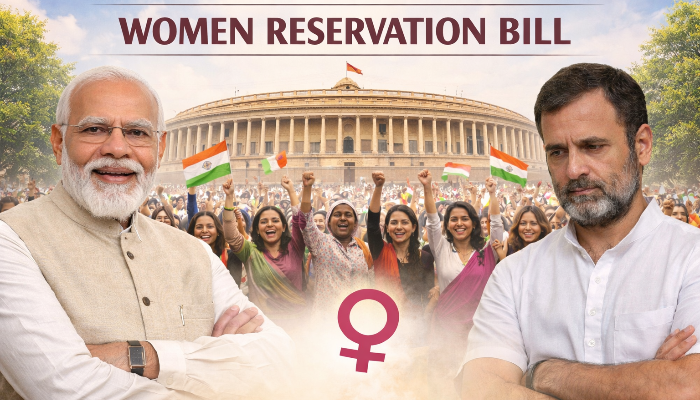
The Women’s Reservation Bill, also known as the Nari Shakti Vandan Adhiniyam, has sparked a political storm in India as opposition parties accuse the government of hypocrisy and political maneuvering. The bill, which aims to reserve 33% of seats in parliamentary and legislative assemblies for women, was announced to be discussed in a special session of Parliament from April 16th to 18th. However, the opposition parties, including the Indian National Congress and Samajwadi Party (SP), have criticized the government for rushing the bill just before state assembly elections, despite earlier demanding an immediate rollout.
Union Minister of Parliamentary Affairs Kiren Rijiju announced the special session, stating that the government is committed to women’s empowerment and urged all parties to work together rather than play politics. “We are convening the Parliament on 16th April. We will take up the Women’s Reservation Bill then. Empowerment of women is our commitment. We must come together for the empowerment of women, not play politics,” he said.
The opposition, however, sees this as a political move. Indian National Congress leader Rahul Gandhi argued that there is no relationship between granting women reservation and the census or delimitation. This comes as a response to the government’s justification for the delay, which has been attributed to the need for a fresh census and delimitation of parliamentary and assembly constituencies.
The Indian National Congress has also complained about a potential breach of the Model Code of Conduct, accusing the center of pursuing political gain prior to the assembly elections. Mallikarjun Kharge, the leader of the opposition in the Rajya Sabha, alleged that he demanded an all-party meeting twice after April 29th. “We are not against women’s reservation. We are the first ones to bring that. It has become unanimous with our support only. These people take credit whenever they want. Everybody agrees, but at what time, how to bring it, and how to do it. Stop your games. If you had to do it, why didn’t you bring it at the beginning of this session? We discussed rural development for three days. Could we not have discussed this? You call after the election. We will all cooperate. Don’t take credit before the election,” he accused.
Kharge was countered by Leader of the House and Union Minister JP Nadda, who charged, “You were not able to pass it in 30 years. We have already taken credit for it. You always see everything from the angle of politics, not humanity.” Rajya Sabha MP Jairam Ramesh likewise insisted, “Kharge had back then demanded that it should be immediately implemented, as you don’t need a census or delimitation, but they said these were necessary. They kept sleeping for 30 months. The only objective of this special session is to take political advantage.”
The opposition’s criticism highlights the broader political dynamics at play. While the government claims to be acting in the interest of women’s empowerment, the opposition argues that the timing is suspect, with state assembly elections looming ahead. The Women’s Reservation Bill has been a contentious issue for years, with debates centered around its implementation and the role of political parties.
The opposition’s call for an all-party meeting suggests a desire for consensus and a shared commitment to the cause. However, the government’s response has been defensive, accusing the opposition of politicizing a social issue. This standoff underscores the challenges of passing progressive legislation in a politically charged environment, where the line between principle and politics can be blurred.
As the debate over the Women’s Reservation Bill continues, the question of whether this is a genuine effort to empower women or a political gambit remains unanswered. The opposition’s accusations of hypocrisy have forced the government to defend its actions, highlighting the complexities of legislative processes in India. The outcome of the special session will be closely watched, as it could set a precedent for future efforts to advance women’s rights in the country.