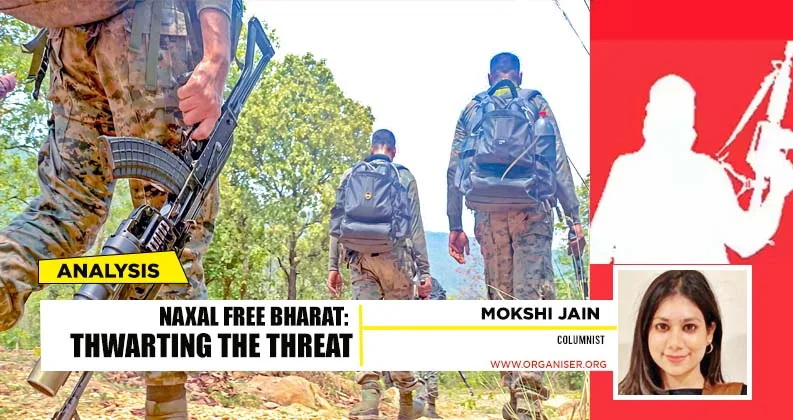
Naxal Free Bharat: Thwarting the threat
A bloody chapter in Bharatiya history finally nears its conclusion. Once boasting a presence across 12 States and dominating 17 per cent of Bharatiya territory, the Maoist terrorism now gasps for breath in merely 2 districts. Union Home Minister Amit Shah recently presented these defining statistics to the Lok Sabha, signalling the imminent death of a ruthless ideological syndicate. For decades, intellectuals peddled a romanticised narrative. They painted Naxalism as a natural rebellion of the marginalised against a failing State. However, the reality reveals a much darker, meticulously calculated strategy. Maoists never cared about poverty. In fact, Naxalism created poverty rather than fighting it. If economic deprivation truly birthed this insurgency, equal poverty in other regions would have spawned similar armed movements. Instead, the architects of this terror deliberately selected inaccessible geographical terrains like dense forests and rugged hills to establish their bases. The roots of this bloodshed did not begin just at Naxalbari in 1967; rather, they can be traced back to the ideological penetration of Maoism in Bharat as early as the 1920s. The events of 1967 only provided this imported doctrine, drawn from China, with a localised identity under the label of “Naxalism.” From there, the movement gradually expanded its geographical and operational footprint towards Southern Bharat. The insurgents envisioned a continuous terror corridor stretching from ‘Pashupati to Tirupati’, a plan actively pursued by the People’s War Group (PWG). Building ‘Liberated Zones’ The organisation systematically built its operational network in Andhra Pradesh before extending its influence into
A bloody chapter in Bharatiya history finally nears its conclusion. Once boasting a presence across 12 States and dominating 17 per cent of Bharatiya territory, the Maoist terrorism now gasps for breath in merely 2 districts. Union Home Minister Amit Shah recently presented these defining statistics to the Lok Sabha, signalling the imminent death of a ruthless ideological syndicate. For decades, intellectuals peddled a romanticised narrative. They painted Naxalism as a natural rebellion of the marginalised against a failing State. However, the reality reveals a much darker, meticulously calculated strategy. Maoists never cared about poverty. In fact, Naxalism created poverty rather than fighting it. If economic deprivation truly birthed this insurgency, equal poverty in other regions would have spawned similar armed movements. Instead, the architects of this terror deliberately selected inaccessible geographical terrains like dense forests and rugged hills to establish their bases.
The roots of this bloodshed did not begin just at Naxalbari in 1967; rather, they can be traced back to the ideological penetration of Maoism in Bharat as early as the 1920s. The events of 1967 only provided this imported doctrine, drawn from China, with a localised identity under the label of "Naxalism." From there, the movement gradually expanded its geographical and operational footprint towards Southern Bharat. The insurgents envisioned a continuous terror corridor stretching from ‘Pashupati to Tirupati’, a plan actively pursued by the People’s War Group (PWG).
Building ‘Liberated Zones’
The organisation systematically built its operational network in Andhra Pradesh before extending its influence into the forested interiors of Chhattisgarh. It identified the Dandakaranya region in Bastar as a strategic base, exploiting its difficult terrain and prevailing administrative vacuum. Following the murder of Pravir Chandra Bhanj Deo, the region experienced a significant leap in Maoist activities. The insurgents established ‘liberated zones’ where they imposed their rule, often through violent means. These zones became hubs for recruitment and training, allowing the Maoists to sustain their operations for decades.
However, the tide has turned. The Bharatiya government’s relentless efforts to dismantle the Maoist infrastructure have been successful. Operation Green Hunt, launched in 2009, marked a turning point in the fight against Naxalism. Thousands of security personnel were deployed across the affected regions, targeting Maoist hideouts and disrupting their supply lines. The government also implemented counter-insurgency strategies, including intelligence-sharing with local communities and providing economic development initiatives to marginalised groups.
The impact of these efforts is evident in the stark statistics presented by Home Minister Amit Shah. The Maoist presence has shrunk to just two districts, a stark contrast to their former dominance. This decline has been accompanied by a significant reduction in violence and atrocities linked to the insurgency. The people of Bharat can now breathe a sigh of relief, knowing that the shadow of Naxalism is fading.
Despite the success in curbing Maoist activities, the challenges remain. The legacy of Naxalism is deeply entrenched in the affected regions, leaving scars of violence and trauma. Rehabilitation efforts are crucial to help former Maoist cadres reintegrate into society. Additionally, addressing the socio-economic issues that fueled the insurgency is essential to prevent its resurgence.
In conclusion, the imminent death of Naxalism signifies a victory for Bharat. The relentless pursuit of justice and the unwavering resolve of the government have finally thwarted the threat posed by this ruthless ideology. As the Maoists gasp for their last breath, Bharat can look forward to a future free from the terror and bloodshed that once defined its landscape. The journey to complete eradication of Naxalism is not yet over, but the path forward is clear, marked by hope and the unyielding spirit of the Bharatiya people.