Home ScienceNature’s strangest eggs—from spongy clusters to ge...
Science⭐ Featured

Nature’s strangest eggs—from spongy clusters to gelatinous blobs

Welcome to the wondrously weird world of eggs. The post Nature’s strangest eggs—from spongy clusters to gelatinous blobs appeared first on Popular Science .
6 April 2026 at 05:48 pm
1 views
Nature’s strangest eggs—from spongy clusters to gelatinous blobs

Nature’s strangest eggs—from spongy clusters to gelatinous blobs

Eggs are not just simple, round, and white. The natural world is filled with a diverse array of egg types, each designed to meet the unique needs of the species that produces them. From spongy clusters to gelatinous blobs, these eggs showcase the incredible adaptability and creativity of nature. Here, we explore three of the most fascinating egg-laying strategies found in the animal kingdom.

Blue crabs and their amazing ‘sponges’

Blue crabs (Callinectes sapidus) have a complex life cycle that involves multiple stages, each requiring different adaptations. As larvae, they live in coastal waters near the mouth of an estuary, settling into sea grasses in brackish water. As juveniles, they migrate to slightly less salty waters to feed and find refuge, maturing and mating in this environment. Mature females then return to the estuary to breed, but lay their eggs in the ocean to ensure the offspring have the best chance of survival.

At each life stage, blue crabs face different challenges, including predators and varying environmental conditions. To address these challenges, mature female blue crabs produce around three million eggs in a single brood, with six to eight broods per season. Each egg is round and yellow-to-orange in color, filled with yolk that supports the development of the embryo into a larva.

One of the most striking features of blue crab reproduction is the way the eggs are carried and protected. Female blue crabs attach their eggs to a specialized structure on their abdomen, forming a spongy cluster known as an egg sponge. This sponge can contain over two million microscopic eggs, each connected by a stiff, bristle-like structure. The egg sponge provides a safe and nurturing environment for the developing larvae, shielding them from predators and ensuring their survival until they are ready to hatch.

Gelatinous salamander eggs

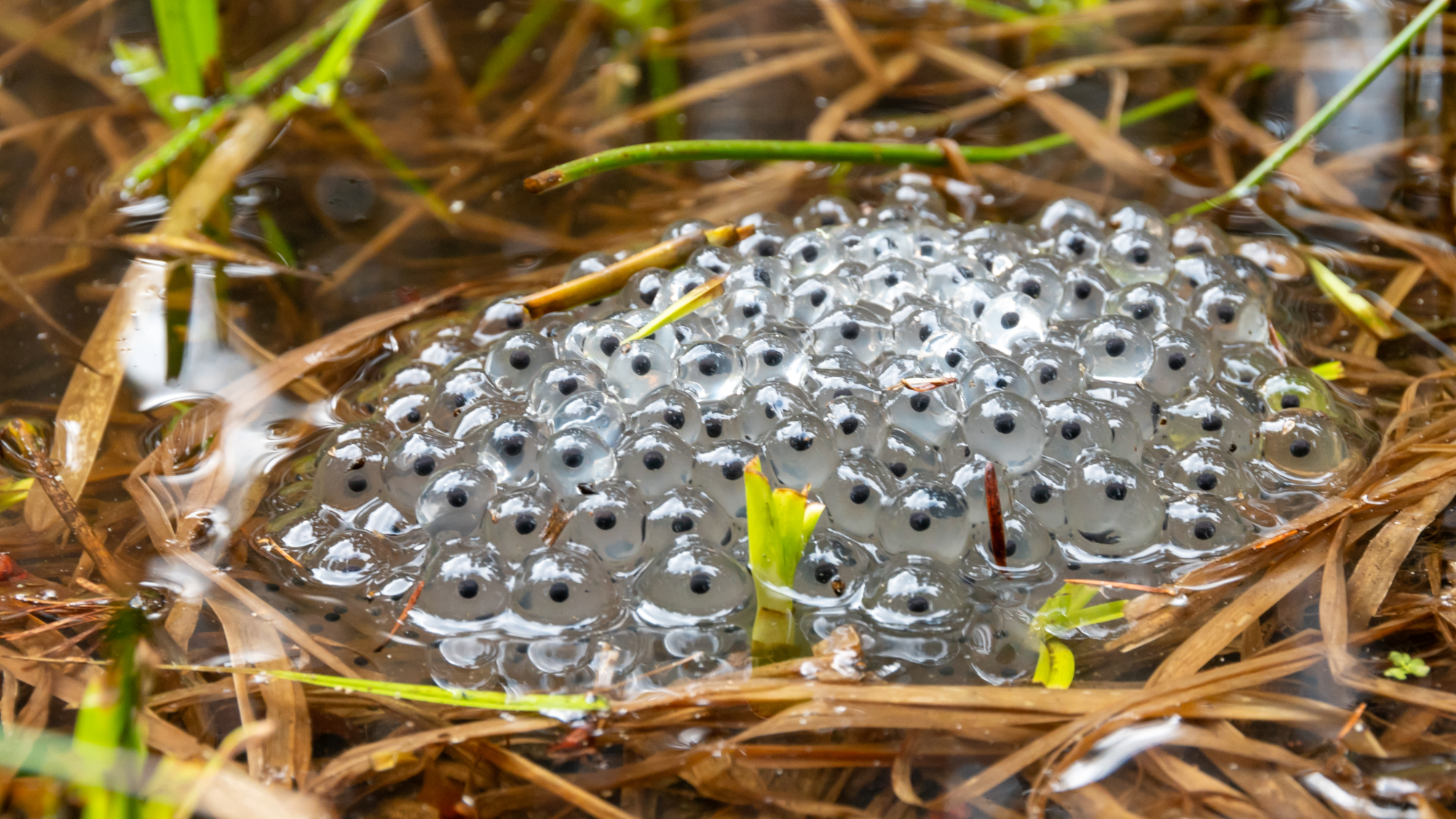
While blue crab eggs are carried by the mother, salamanders lay their eggs in a completely different manner. Some species of salamanders, such as the red-spotted newt, produce gelatinous egg masses that are deposited in water. These egg masses are formed by the female salamander secreting a jelly-like substance that hardens into a protective capsule. Inside this capsule, the eggs are encased in a gelatinous matrix, which provides nourishment and protection from predators and environmental factors.

The gelatinous egg mass offers several advantages. First, it protects the eggs from desiccation, ensuring that they remain moist and viable. Second, the gelatinous matrix acts as a food source for the developing embryos, providing them with the necessary nutrients to grow and develop until they are ready to hatch. Finally, the egg mass offers a degree of protection from predators, as the gelatinous structure can deter some would-be eaters.

Other unique egg-laying strategies

Nature’s egg-laying strategies are not limited to blue crabs and salamanders. Many other species have evolved unique methods for protecting and nurturing their offspring. For example, some bird species, like the kiwi, lay leathery eggs that are incubated by both parents. These eggs are designed to withstand the harsh New Zealand environment, where predators such as stoats and rats are prevalent.

In contrast, certain fish species, like the male clownfish, carry their fertilized eggs in a specialized pouch on their lower jaw. This pouch provides a safe and protected environment for the developing fry, shielding them from predators and ensuring their survival until they are ready to swim independently.

These examples illustrate the incredible diversity and adaptability of nature’s egg-laying strategies. Each species has evolved unique methods to ensure the survival of its offspring, taking into account factors such as predation risk, environmental conditions, and the need for nourishment. From spongy clusters to gelatinous blobs, these eggs are a testament to the ingenuity and resilience of the natural world.

📰 Related News
The largest orbital compute cluster is open for business | TechCrunch
Kepler Communications is flying 40 GPUs in Earth orbit. And its latest customer is Sophia Space.
14 Apr
‘Mideast conflict poses risks to Philippines growth’
The Philippine economy is expected to grow at a faster pace of 5.3 percent this year from last year’s 4.4 percent but the ongoing Middle East conflict is seen to pose risks, according to the Association of Southeast Asian Nations Plus 3 Macroeconomic Research Office.
7 Apr
AFBI welcomes DUP representatives to its research farm at Hillsborough
The Agri-Food and Biosciences Institute (AFBI) welcomed a number of DUP representatives to its research farm at Hillsborough on Friday.
7 Apr
A simple way to get more value from metrics
We spent one day 1 building a system that immediately found a mid 7 figure optimization (which ended up shipping). In the first year, we shipped mid 8 figures per year worth of cost savings as a result. The key feature this system introduces is the ability to query metrics data across all hosts and all services and over any period of time (since inception), so we've called it LongTermMetrics (LTM) internally since I like boring, descriptive, names. This got started when I was looking for a starter project that would both help me understand the Twitter infra stack and also have some easily quantifiable value. Andy Wilcox suggested looking at JVM survivor space utilization for some large services. If you're not familiar with what survivor space is, you can think of it as a configurable, fixed-size buffer, in the JVM (at least if you use the GC algorithm that's default at Twitter). At the time, if you looked at a random large services, you'd usually find that either: The buffer was too small, resulting in poor performance, sometimes catastrophically poor when under high load. The buffer was too large, resulting in wasted memory, i.e., wasted money. But instead of looking at random services, there's no fundamental reason that we shouldn't be able to query all services and get a list of which services have room for improvement in their configuration, sorted by performance degradation or cost savings. And if we write that query for JVM survivor space, this also
7 Apr
Accelerating Mathematical and Scientific Discovery with Gemini Deep Think
Research papers point to the growing impact of Deep Think across fields
7 Apr
Gemini 3 Deep Think: Advancing science, research and engineering
Our most specialized reasoning mode is now updated to solve modern science, research and engineering challenges.
7 Apr
Context Engineering for Coding Agents
The number of options we have to configure and enrich a coding agent’s context has exploded over the past few months. Claude Code is leading the charge with innovations in this space, but other coding assistants are quickly following suit. Powerful context engineering is becoming a huge part of the developer experience of these tools. Birgitta Böckeler explains the current state of context configuration features, using Claude Code as an example. more…
7 Apr
What does less protein and nitrogen mean for methane?
Does feeding less protein to cows over a longer period not only reduce nitrogen losses, but also affect methane emissions? Researchers at Wageningen University & Research (WUR) investigated this in a multi-year study with dairy cows, funded by the Vereniging Diervoederonderzoek Nederland (VDN), the Dutch Ministry of Agriculture, Fisheries, Food Security and Nature (LVVN), and […] The post What does less protein and nitrogen mean for methane? appeared first on Agriland.ie .
7 Apr
Second’s Bark Boasts New era of Bitcoin Payments, drawing in former Blockstream developers
Bitcoin Magazine Second’s Bark Boasts New era of Bitcoin Payments, drawing in former Blockstream developers Second, the Bitcoin development lab founded by ex-Blockstream executives including CEO Steven Roose and CTO Erik De Smedt, has unveiled Bark — its custom Ark protocol implementation promising self-custodial payments that are faster and cheaper than Lightning channels. This post Second’s Bark Boasts New era of Bitcoin Payments, drawing in former Blockstream developers first appeared on Bitcoin Magazine and is written by Juan Galt .
7 Apr
'Morale boost': Nasa carries out Moon mission during tough year for science
HOUSTON — As the four Artemis astronauts approached a high point of their lunar mission -- getting slung around the far side of the Moon -- National Aeronautics and Space Administration (Nasa) staffers crowded into Houston's famed mission control room Monday for a team photo.
7 Apr