
Mitad de agua, rendimientos competitivos: INTA avanza en la investigación sobre riego de quinua
Investigación de INTA San Juan muestra que la quinoa puede rendir competitivamente en Cuyo usando solo la mitad del agua indicada por referencias internacionales. Con 260–290 mm por ciclo, la variedad Morrillos INTA logró cerca de 1,7 t/ha, con una reducción de rendimiento de 10–20% y buena calidad de grano. El riego por goteo permite control preciso y ahorro hídrico. The post Mitad de agua, rendimientos competitivos: INTA avanza en la investigación sobre riego de quinua appeared first on Seed World .
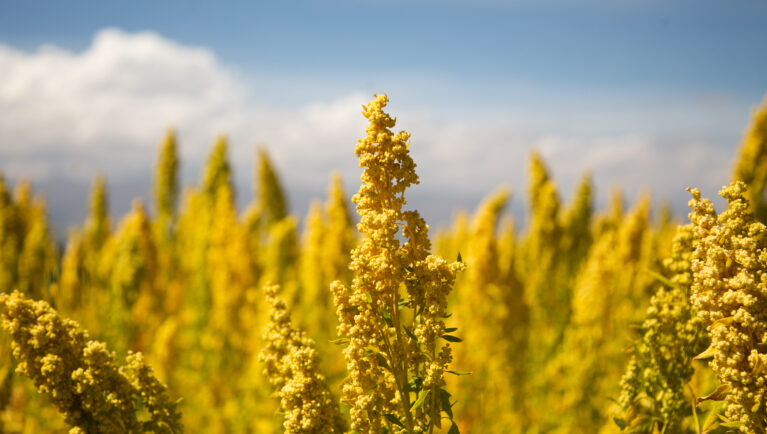
The quinoa plant has been consolidating itself as a productive option in the Cuyo region, and the National Institute of Agricultural Technology (INTA) has taken a significant step towards its consolidation. A study conducted in San Juan has revealed that the crop can complete its cycle and achieve competitive yields using only half the water suggested by international parameters. This finding is strategically important as it provides, for the first time, precise and locally generated data on the water requirements of quinoa under irrigation, an essential input for production decisions in the region.
According to Nadia Bárcena, an INTA San Juan researcher, the study evaluated the quinoa's response to different irrigation regimes to determine how much water it actually needs to reach its productive potential under local conditions. "What we are observing regarding the different water treatments applied in terms of water use is that with 50% of the total required according to the literature, we achieve good potential yields, around 1,700 kilograms per hectare," Bárcena explained. This management equates to an accumulated layer of between 260 and 290 millimeters during the cultivation cycle, a value significantly lower than the one taken as a reference from countries where quinoa is native.
The result is significant. With this level of irrigation, the quinoa completes its development with a reduction in yield of only 10-20% compared to the maximum theoretical yield, without significant losses and maintaining good grain quality, according to a press release. "In addition to not registering significant yield drops, we also observed adequate quality, although the grain size may be slightly affected," the researcher detailed.
The study has already accumulated three consecutive campaigns and is carried out with the Morrillos INTA variety. Over this period, the team has evaluated the crop's behavior in response to different water inputs. The use of drip irrigation allows for precise control and water savings, which is crucial in regions with water scarcity. This innovative approach not only optimizes water use but also supports sustainable agricultural practices, making quinoa production more viable and competitive in the Cuyo region.
The findings from this research have important implications for the agricultural sector in Argentina and beyond. By reducing water consumption while maintaining competitive yields and grain quality, quinoa cultivation can become more environmentally friendly and economically sustainable. This knowledge can also be applied to other crops that require significant water inputs, contributing to more efficient and adaptable agricultural systems in the face of climate change and water scarcity challenges.
In conclusion, the INTA's research on quinoa irrigation in San Juan represents a breakthrough in agricultural science and practice. By demonstrating that the crop can thrive with reduced water usage, the study paves the way for more sustainable and productive agriculture in the Cuyo region and beyond. This innovative approach not only supports the growth of the quinoa industry but also contributes to the development of resilient and adaptable agricultural systems in the face of global challenges.









