Mahakal Standard Time To Replace GMT? What Is The Proposal To Make Ujjain The Prime Meridian?
Mahakal Standard Time To Replace GMT? Proposed by Dharmendra Pradhan, the system argues that Ujjain is the scientifically and historically accurate "centre of time"
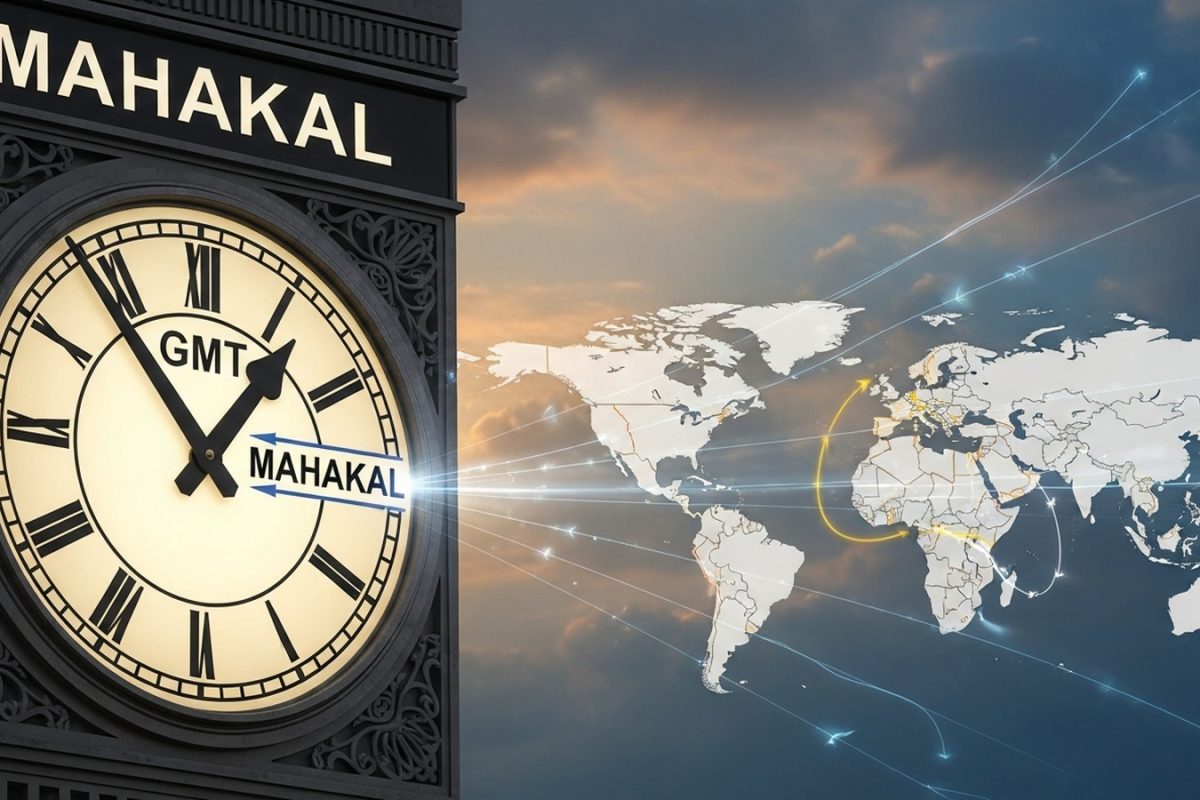
In a surprising proposal that has sparked debate and discussion across the globe, India's Minister of Petroleum and Natural Gas, Dharmendra Pradhan, has suggested that Mahakal Standard Time (MST) should replace Greenwich Mean Time (GMT) as the international standard. The idea centers around the ancient city of Ujjain, which the proposal claims is the scientifically and historically accurate "centre of time." This move would not only redefine the way the world measures time but also place India at the heart of a global timekeeping system, a concept that has captivated historians, scientists, and policymakers alike.
The proposal for Mahakal Standard Time is rooted in historical and scientific evidence. Ujjain, a city in the state of Madhya Pradesh, has long been revered as a significant center of astronomical studies in ancient India. The city's strategic location, situated approximately 75 degrees 30 minutes east of the Prime Meridian, has led some scholars to argue that it was historically considered the midpoint of the Earth. This belief is supported by ancient texts, including the "Aryabhatiya," an influential work on Indian astronomy attributed to the mathematician and astronomer Aryabhata, who lived in Ujjain around the 5th century CE. Aryabhata's calculations and observations were groundbreaking, and his work laid the foundation for the development of timekeeping systems in both India and the Islamic world.
The idea of Ujjain as the "centre of time" is not merely a historical curiosity. It is also supported by modern scientific analysis. The Prime Meridian, currently defined as passing through Greenwich, England, was established in 1884 during the International Meridian Conference. However, the choice of Greenwich was largely political, as it was the home port of the British Empire, which dominated global trade and exploration at the time. The conference's decision to select Greenwich as the Prime Meridian was influenced by Britain's geopolitical interests rather than any scientific rationale.
Proponents of the Mahakal Standard Time proposal argue that Ujjain's historical and scientific significance makes it a more appropriate choice for the Prime Meridian. They contend that the shift would recognize the contributions of ancient Indian astronomers and mathematicians, who made groundbreaking discoveries that influenced global scientific thought. By adopting Mahakal Standard Time, the world would be acknowledging the rich heritage of India's scientific and mathematical traditions, which have been pivotal in shaping our understanding of the universe.
The proposal has been met with mixed reactions. Supporters of the idea argue that it would be a fitting tribute to India's historical and scientific achievements. They believe that the shift would not only honor the contributions of ancient Indian scholars but also promote greater cultural and scientific collaboration between nations. Critics, however, question the practicality and feasibility of such a change. They point out that the global adoption of a new time standard would be a complex and costly process, involving the recalibration of clocks, the updating of systems, and the retraining of personnel in various sectors, including aviation, telecommunications, and finance.
Moreover, the idea of redefining the Prime Meridian raises questions about the role of geopolitics in scientific discourse. While the choice of Greenwich in 1884 was undeniably influenced by political considerations, the proposal to shift the Prime Meridian to Ujjain could be seen as another instance of geopolitical maneuvering. Critics argue that the decision to adopt a new time standard should be based on scientific merit rather than national pride or political ambition.
Despite the controversies surrounding the proposal, the idea of Mahakal Standard Time has sparked a global debate about the nature of time and its measurement. The discussion has highlighted the interplay between history, science, and politics in shaping our understanding of the world. It has also brought to light the need for a more inclusive and equitable approach to scientific and cultural heritage, one that recognizes the contributions of all civilizations, not just those from Western Europe.
In conclusion, the proposal to replace GMT with Mahakal Standard Time, centered around Ujjain, is a bold and ambitious idea that challenges the established global timekeeping system. While it has been met with both support and criticism, the debate it has sparked serves as a reminder of the complex interplay between history, science, and politics. Ultimately, the decision to adopt a new time standard will require careful consideration of both practical and symbolic considerations. As the world continues to grapple with this proposal, it is clear that the concept of "centre of time" remains a captivating and evolving idea, one that reflects our ever-changing understanding of the world and our place within it.