Keralam Election 2026 l If elected, LDF & UDF will enable ‘love jihad’ targeting Hindu & Christian girls: Krishnadas
Thiruvananthapuram: Former BJP state president and Kattakada Assembly candidate P. K. Krishnadas has alleged that if the CPI(M)-led Left Democratic Front (LDF) or the Congress Muslim league -led United Democratic Front (UDF) comes to power in Keralam, they would enable activities for “love jihad,” targeting girls from Hindu and Christian families under the pretext of relationships. He further claimed that such developments could be linked to anti-national activities carried out in the name of love. Krishnadas made these remarks while addressing a public meeting in Kattakada, which was attended by Union Home Minister Amit Shah. He presented these allegations to argue that the LDF and the UDF are effectively aligned in their functioning. According to her, if either front comes to power, the government would be influenced or controlled by organisations such as Jamaat-e-Islami and the PFI-linked Social Democratic Party of India (SDPI), which he characterised as having agendas detrimental to national interests. He stated that under such a scenario, young women from Hindu and Christian households could be drawn into activities framed as relationships but serving larger political or ideological purposes. Krishnadas used this line of argument to reinforce his broader claim that there is little substantive difference between the Marxist Party and the Congress in terms of political outcomes. High-Stakes Contest for Key Leaders Meanwhile, the Kerala Assembly election has become highly competitive, with sharp political exchanges and intense scrutiny of leadership across both the LDF and the UDF. Chief Minister Pinarayi Vijayan, CPI(M) state secretary M. V.
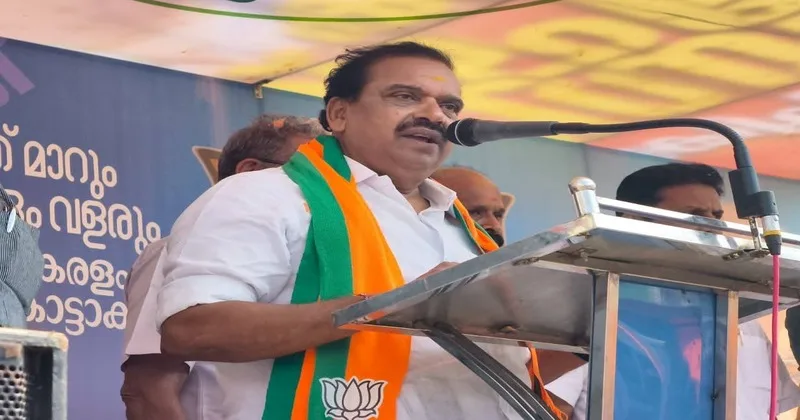
Thiruvananthapuram: In a recent development, former BJP state president and Kattakada Assembly candidate P. K. Krishnadas has accused the CPI(M)-led Left Democratic Front (LDF) and the Congress Muslim League-led United Democratic Front (UDF) of enabling "love jihad" activities targeting Hindu and Christian girls if they were to come to power in Kerala. Krishnadas made these allegations during a public meeting in Kattakada, which was attended by Union Home Minister Amit Shah.
Krishnadas claimed that if either the LDF or the UDF were to win the upcoming elections, the government would be influenced or controlled by organizations such as Jamaat-e-Islami and the PFI-linked Social Democratic Party of India (SDPI), which he described as having agendas detrimental to national interests. He argued that under such a scenario, young women from Hindu and Christian households could be drawn into activities that are framed as relationships but serve larger political or ideological purposes.
Krishnadas used this line of argument to reinforce his broader claim that there is little substantive difference between the Marxist Party and the Congress in terms of political outcomes. He suggested that both fronts are effectively aligned in their functioning and could enable activities that threaten the safety and well-being of women from minority religious backgrounds.
The Kerala Assembly election has become highly competitive, with sharp political exchanges and intense scrutiny of leadership across both the LDF and the UDF. Key leaders such as Chief Minister Pinarayi Vijayan, CPI(M) state secretary M. V. Govindan, AICC general secretary K. C. Venugopal, and Opposition Leader V. D. Satheesan are among those whose leadership and strategies are under close watch.
Within the Congress, internal dynamics surrounding leadership and candidate selection have come into focus. K. C. Venugopal and V. D. Satheesan are seen as playing central roles in shaping the party's strategy and selecting candidates for the upcoming elections. The competition between these leaders and their respective factions is expected to influence the party's performance in the polls.
The allegations made by Krishnadas have sparked a debate about the role of political fronts in Kerala and their potential impact on the state's social fabric. Critics argue that such claims are politically motivated and designed to appeal to a specific section of the electorate. On the other hand, supporters of Krishnadas believe that his allegations highlight a genuine concern about the safety of women in Kerala and the need for stronger measures to protect them.
As the election campaign intensifies, both the LDF and the UDF are expected to respond to these allegations and defend their record on women's safety and social harmony. The outcome of the election will likely depend on how effectively these fronts address the concerns of the electorate and present a compelling vision for the future of Kerala.
In conclusion, the Kerala Assembly election of 2026 has taken on an additional layer of complexity due to the allegations of "love jihad" and the claims of political alignment between the LDF and the UDF. The election will be closely watched not only for its political implications but also for its potential impact on the social and religious dynamics of the state. The ability of the political fronts to address these concerns and present a unified front will be crucial in determining the outcome of the election.