Kant on the metaphysical foundation of inertia
.
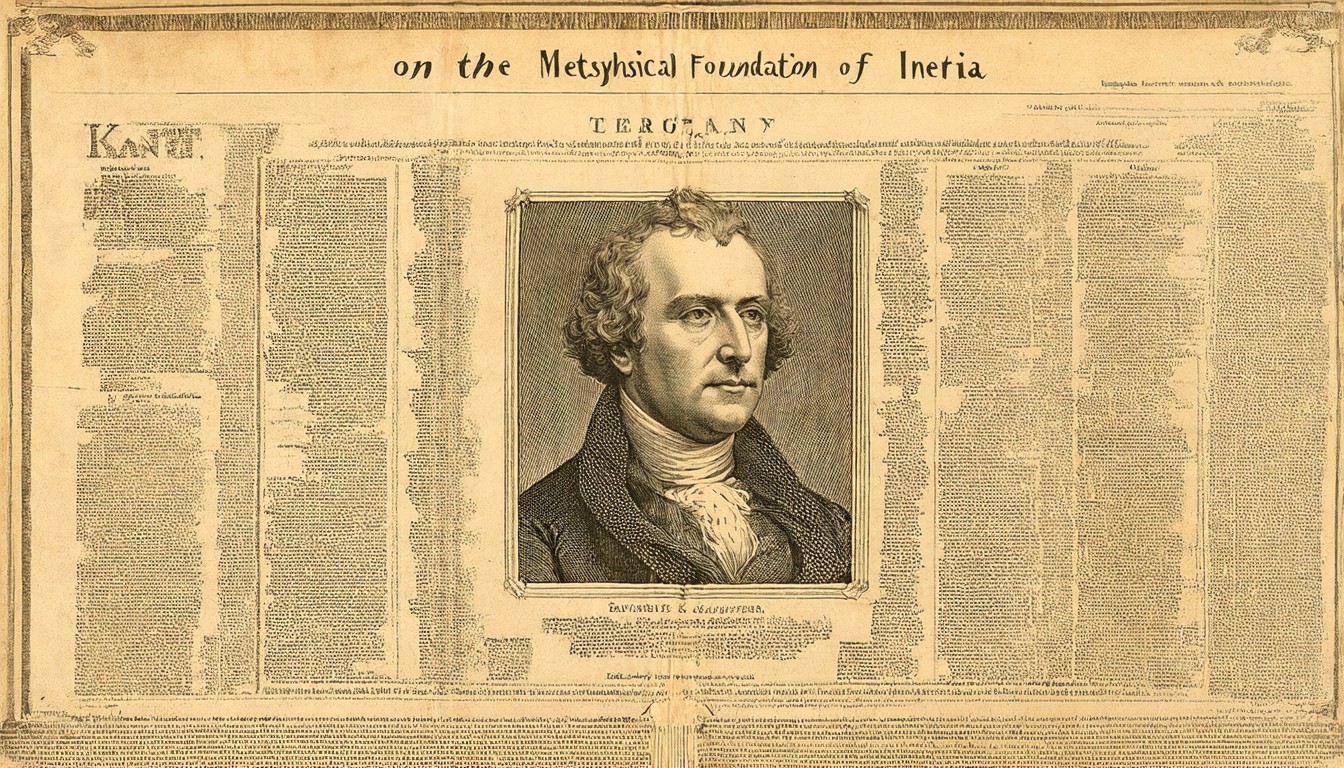
Immanuel Kant's exploration of the metaphysical foundation of inertia is a cornerstone of his philosophical system, particularly in his work "Critique of Pure Reason." Inertia, the resistance of an object to changes in its motion, has long been a subject of inquiry in both physics and philosophy. Kant sought to address this concept by examining the relationship between the physical world and our perception of it, ultimately aiming to ground metaphysics in a more rigorous foundation.
Kant's approach to inertia begins with his distinction between phenomena and noumena. Phenomena are the objects of experience, while noumena are the things-in-themselves, independent of our perception. Inertia, as a property of physical objects, is a phenomenon. However, Kant argues that inertia cannot be fully understood without considering the role of the mind in structuring our experience of the world.
Inertia, for Kant, is not merely an empirical observation but a necessary condition for the possibility of experience. He posits that inertia is a synthetic a priori concept, meaning it is not derived from experience but is a necessary presupposition for organizing sensory data. This synthetic a priori nature of inertia implies that it is not merely a descriptive term but a fundamental principle that shapes our understanding of the physical world.
Kant's analysis of inertia is closely tied to his concept of causality. He argues that inertia is the basis for the principle of causality, which states that "if under the same conditions, the same cause always produces the same effect." Inertia, as the resistance to change in motion, is the grounding principle that allows us to predict and understand causal relationships in the world. Without inertia, the very notion of causality would be unintelligible, as there would be no stable foundation for the connection between cause and effect.
Furthermore, Kant's examination of inertia leads him to consider the role of the mind in shaping our experience of the physical world. He contends that the concept of inertia is not merely a passive reflection of an external reality but is an active construction of the mind. The mind imposes the category of inertia on sensory experience, thereby organizing and structuring our perception of the world.
This view of inertia as a synthetic a priori concept has significant implications for metaphysics. By grounding inertia in the mind's structure of experience, Kant suggests that metaphysical claims about the nature of reality must be compatible with the categories through which we perceive the world. This means that metaphysical propositions cannot be verified through empirical observation alone but must also be consistent with the necessary structures of our understanding.
Kant's exploration of inertia also has broader philosophical ramifications. His analysis of inertia as a synthetic a priori concept challenges the traditional division between empirical and rational knowledge. By demonstrating that inertia is both a necessary presupposition for experience and a product of the mind's structure, Kant bridges the gap between the two, suggesting that metaphysics and empiricism are not mutually exclusive but rather complementary.
In conclusion, Immanuel Kant's examination of the metaphysical foundation of inertia is a pivotal contribution to both philosophy and the understanding of the physical world. By grounding inertia in the mind's structure of experience and demonstrating its synthetic a priori nature, Kant provides a new foundation for metaphysics. His work not only redefines our understanding of inertia but also challenges traditional boundaries between empirical and rational knowledge, offering a more nuanced and integrated view of human understanding.