“Islamist Radicals Pick Guruvayur LDF-UDF Candidates”: B. Gopalakrishnan Doubles Down on 50-Year ‘Hidden Agenda’ Claim
Guruvayur has always been more than a constituency. It is the spiritual address of millions — the home of Lord Guruvayurappan, one of the most visited Krishna temples in the country, a town where the air smells of camphor before the sun rises and pilgrims arrive in the dark to join queues that stretch through the morning. But ahead of the 2026 Assembly elections, it has become something else too: the place where fifty years of carefully maintained political silence has finally been broken. The man who broke it is Adv. B. Gopalakrishnan, the BJP candidate for Guruvayur — a devoted bhakta who offers Shayana Pradakshinam at the temple every month and who walked into this campaign carrying a vigilance report in one hand and a flex board full of names in the other. The board listed every MLA Guruvayur had elected since 1977. Name, party, community. Gopalakrishnan installed it near Chavakkad junction without ceremony and waited. The data spoke for itself: since 1976, across five decades and multiple elections, neither the Congress-led UDF nor the CPI(M)-led LDF had once fielded a Hindu candidate in a constituency where Hindus form 52 percent of the electorate. The town has not stopped talking about it since. “I put the names up on a board and asked — is there a pattern here? That question apparently terrified both fronts enough that they ran to the courts and the police station. If I had shown a false chart, they would have corrected it. They
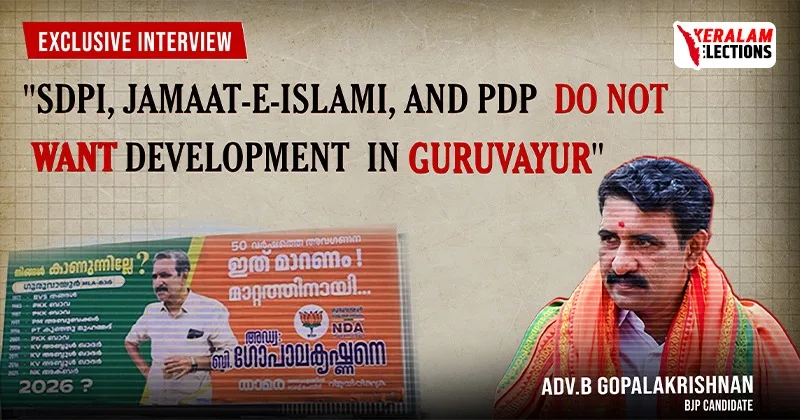
Guruvayur, a town steeped in spiritual significance as the home of Lord Guruvayurappan and one of the most visited Krishna temples in India, has become an unexpected battleground in the lead-up to the 2026 Assembly elections. The air that once carried the scent of camphor and the hum of devotion now carries the tension of political rivalry, as the town has become the stage for a fifty-year-old claim of a "hidden agenda" by Adv. B. Gopalakrishnan, the BJP candidate for Guruvayur.
Gopalakrishnan, a devout bhakta who performs Shayana Pradakshinam at the temple every month, entered the campaign with a vigilance report in hand and a flex board displaying the names of every MLA elected from Guruvayur since 1977. The board listed their names, parties, and communities, and he installed it near Chavakkad junction without fanfare, simply waiting for the data to speak for itself.
The numbers told a story that had been hidden in plain sight for decades. Since 1976, across five elections and multiple political shifts, neither the Congress-led United Democratic Front (UDF) nor the Communist Party of India (Marxist)-led Left Democratic Front (LDF) had ever fielded a Hindu candidate in a constituency where Hindus made up 52 percent of the electorate. The revelation sent shockwaves through the town, sparking conversations among residents and igniting political tensions.
"I put the names up on a board and asked — is there a pattern here?" Gopalakrishnan recounted. "That question apparently terrified both fronts enough that they ran to the courts and the police station. If I had shown a false chart, they would have corrected it. They couldn't."
The political establishment's response was swift and, for the BJP, more effective than any campaign speech. Three First Information Reports (FIRs) were filed against Gopalakrishnan, and on the morning he submitted his nomination papers, advocates linked to both the UDF and LDF appeared before the returning officer, arguing jointly that his candidacy should not be accepted. The rival fronts, once divided, briefly united in their opposition to Gopalakrishnan's candidacy.
The town's reaction to these developments was a mix of curiosity and outrage. Many residents, who had long been unaware of the pattern in their constituency's political history, were now questioning the fairness of the electoral process. The revelation of the "hidden agenda" had broken a fifty-year silence, forcing both the UDF and LDF to confront the accusations head-on.
Gopalakrishnan's campaign, centered around transparency and accountability, has gained traction in the town. His simple act of displaying the names of elected MLAs has sparked a conversation about representation and political inclusivity. The BJP candidate's claim has not only challenged the traditional political dynamics of Guruvayur but has also drawn attention to the broader issue of community representation in politics.
As the 2026 Assembly elections approach, Guruvayur stands as a microcosm of the larger political battle in Kerala. The town's residents, who once came together in unity at the temple, are now divided by political allegiances and the accusations of a hidden agenda. The case of Adv. B. Gopalakrishnan and his fifty-year claim is not just about one constituency but about the future of political representation and the role of transparency in shaping democratic processes.
The town of Guruvayur, once a place of spiritual solace, has become a stage for political confrontation. The revelation of the "hidden agenda" has shattered decades of political silence, forcing both the UDF and LDF to confront the accusations. As the election campaign heats up, the question of representation and the role of transparency in politics remains at the forefront of public discourse. The case of Adv. B. Gopalakrishnan serves as a reminder that even in the most sacred of places, politics can stir up unrest and challenge the status quo.