Is Meta India compromised? Pro-Congress leadership under scrutiny after Facebook faces heat for pushing anti-Modi propaganda
After netizens questioned Rao’s position, her husband Muhammad Khan, linked to Congress media team, threatened legal action, called the posts harassment, and said screenshots had been taken.
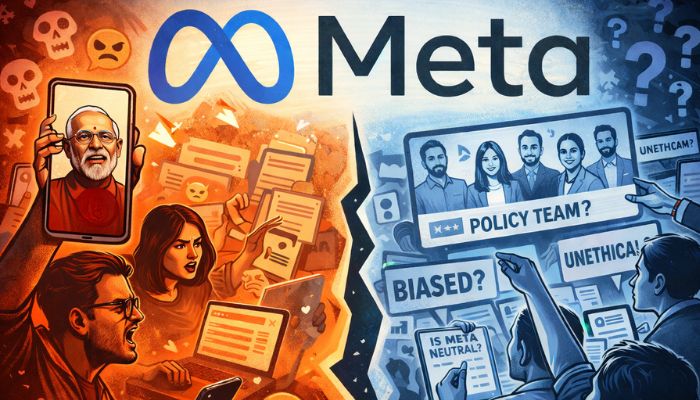
Over the weekend, social media erupted with claims that Meta India's content moderation and policy decisions have increasingly aligned with an anti-Modi narrative. The controversy gained momentum as users shared posts suggesting their Facebook and Instagram feeds were being inundated with anti-government content. One widely circulated post by a social media user with the handle HPhobiaWatch highlighted the issue, stating, "Entire Facebook has turned anti-Modi in the last 6 to 8 months… whenever I open Facebook, I just see anti-Modi posts with 50k likes."
This sparked a broader discussion about individuals occupying policy roles within Meta India. The conversation quickly centered around Prianka Rao Khan, a Meta India public policy executive. A reply to HPhobiaWatch's post pointed out Prianka's role, leading to a wider thread that snowballed into speculation about her ideological leanings. Screenshots of Prianka's social media activity, profile details, and professional associations surfaced, with netizens attempting to draw conclusions based on content she had shared in the past.
Prianka Rao Khan, who is married to Muhammad Khan—a member of the Congress media team—has been the subject of scrutiny. In 2019, she secured a spot at Oxford's Blavatnik School of Government to train as a leader. During her time at Oxford, she spent days organizing protests and crafting narratives that painted the Indian government in a negative light. She held placards calling elected Indian leaders "NAZIS" and participated in protests against Prime Minister Narendra Modi.
In February this year, screenshots of Prianka's Twitter profile had gone viral, showing a banner with placards calling Modi a "Nazi." This led to her removing the banner. Recently, Prianka changed her Twitter header, replacing the protest picture with a new profile picture. Her earlier Twitter header featured placards reading "Shah Modi Nazi" and "Modi... The End is Nigh."
The controversy has raised questions about the independence of Meta India's content moderation and policy decisions. Some users have accused the company of bias, alleging that it is disproportionately promoting anti-Modi content. This comes as tensions between the Indian government and Meta India have been high in recent months, with the government expressing concerns over the spread of misinformation and hate speech on the platform.
In response to the allegations, Prianka Rao Khan's husband, Muhammad Khan, threatened legal action against those who questioned her position. He called the posts harassment and stated that screenshots had been taken. This has only fueled further speculation and debate about the influence of political affiliations on Meta India's operations.
The situation has also drawn attention to the role of social media in shaping public opinion and the potential impact of individuals in policy roles on content moderation. As Meta India faces scrutiny, questions remain about the company's commitment to maintaining a neutral platform and its ability to uphold editorial independence in the face of political pressures.
The controversy has divided social media, with some users demanding transparency from Meta India and calling for an independent investigation into its content moderation practices. Others have defended the company, arguing that it is merely a platform for free expression and that users should be responsible for the content they consume.
As the debate continues, it is clear that the allegations against Meta India have raised serious concerns about the potential for political bias in content moderation and policy decisions. The situation underscores the need for companies to ensure that their operations remain independent and free from undue influence, particularly in the context of sensitive political issues.
In the coming days, it will be interesting to see how Meta India responds to these allegations and whether any action is taken to address the concerns raised by users. The situation serves as a reminder of the significant role that social media platforms play in shaping public discourse and the importance of maintaining editorial integrity in an increasingly polarized world.