India introduces tunnel hoods for bullet train mountain tunnels
The National High Speed Rail Corporation has introduced tunnel hoods at mountain tunnel portals on the Mumbai-Ahmedabad bullet train corridor, a first for railway tunnels in India. The technology addresses aerodynamic challenges in high-speed rail through mountainous terrain.
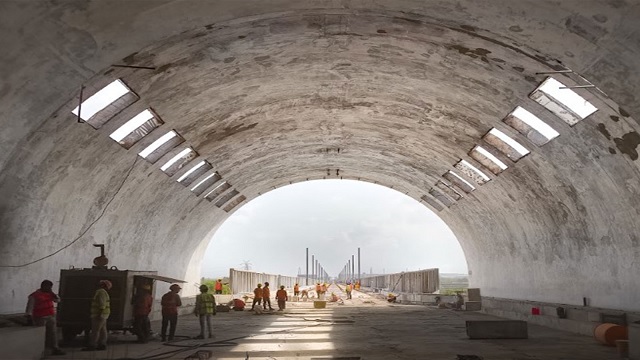
The National High Speed Rail Corporation Limited has introduced tunnel hoods at mountain tunnel portals on the Mumbai-Ahmedabad bullet train corridor, marking the first time such technology has been designed and implemented for railway tunnels in India. The tunnel hoods are being installed at the entrances and exits of mountain tunnels along the high-speed rail alignment. These structures are engineered to manage the rapid air pressure changes that occur when a train traveling at over 300 kilometers per hour enters or leaves a confined tunnel space.
Without such mitigation, the sudden compression and expansion of air can cause a loud sonic boom effect, discomfort for passengers, and structural stress on both the train and the tunnel lining. The hoods feature specially designed openings and louver systems that gradually release or admit air, smoothing the pressure wave. The Mumbai-Ahmedabad High Speed Rail corridor, which will eventually connect India’s financial capital with Gujarat’s commercial hub, passes through sections of the Western Ghats and other hilly regions.
These mountain tunnels present unique aerodynamic challenges that are less pronounced on flat terrain. NHSRCL officials have stated that the design of these tunnel hoods was developed specifically for the geological and operational conditions of the Indian route. While similar structures are standard on high-speed lines in Japan, France, and China, this is their debut on a railway project within India. The bullet train project, which is being built with technical assistance from Japan, has faced multiple delays due to land acquisition issues and the COVID-19 pandemic.
However, civil construction on the 508-kilometer route has progressed in several stretches, particularly in Gujarat and Maharashtra. Tunnel hoods are part of a broader set of advanced engineering solutions being deployed on the corridor. Other features include seismic-resistant viaducts, noise barriers, and an automatic train control system. The project aims to eventually reduce travel time between Mumbai and Ahmedabad to under three hours. The introduction of tunnel hoods also has implications for maintenance and operational costs.
By reducing the intensity of pressure waves, the hoods lower the fatigue load on tunnel linings and train bodies, potentially extending the service life of both infrastructure and rolling stock. Environmental considerations have also influenced the design. The hoods are being constructed with materials that blend into the surrounding landscape, and their acoustic dampening properties will reduce noise pollution for communities near tunnel portals. NHSRCL has not disclosed the exact number of tunnel hoods planned for the corridor or the total length of mountain tunnels that will be equipped.
However, the agency has confirmed that the design phase is complete and installation is underway at multiple sites. The Mumbai-Ahmedabad bullet train is India’s first high-speed rail project and is expected to carry an estimated 1. 6 crore passengers annually once fully operational. The project is a flagship initiative of the central government and is being monitored at the highest levels. Industry experts note that the adoption of tunnel hood technology signals India’s growing capability in high-speed rail engineering.
As the country plans additional bullet train corridors, including Delhi-Varanasi and Chennai-Mysuru, the lessons learned from the Mumbai-Ahmedabad project will inform future designs. The tunnel hood installation is a relatively small but technically significant component of a massive infrastructure undertaking. It demonstrates how global best practices are being adapted to Indian conditions, rather than simply copied. For now, the focus remains on completing the mountain tunnel sections, which are among the most challenging parts of the alignment.
The successful deployment of tunnel hoods will be a key milestone in proving the project’s technical readiness.