
How the US unleashed overwhelming firepower to save stranded airman under enemy fire in Iran... then obliterated every weapon left behind
The pilot was rescued by two military helicopters that same day, but the airman remained missing for nearly 48 hours, managing to evade Iranians for nearly two days.
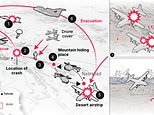
In a dramatic display of military might, the United States deployed its overwhelming firepower to rescue a stranded airman who had been evading Iranian forces for nearly two days. The operation unfolded in the aftermath of a previous rescue mission, where a pilot was successfully extracted by two military helicopters. However, the airman, whose identity remains undisclosed, faced a harrowing ordeal as he navigated through enemy territory, relying on his training and wits to avoid capture.
The initial rescue mission took place on a tense day when American forces had to act swiftly to secure the pilot's safety. Two military helicopters, equipped with advanced stealth technology and heavily armed, infiltrated the area with precision. The operation was meticulously planned, taking into account the potential threats posed by Iranian forces. The helicopters approached the scene stealthily, their rotors whirring quietly in the night air, as they descended to pick up the pilot. The extraction was executed with military precision, and the pilot was safely transported to a secure location.
However, the mission was not yet complete. The airman, who had been separated from the pilot, faced a daunting challenge. With Iranian forces closing in, he had to rely on his survival skills to evade capture. For nearly 48 hours, he managed to stay one step ahead of his pursuers, navigating through rugged terrain and relying on his knowledge of the area to avoid detection. His resilience and determination were put to the test as he waited for rescue.
As the hours passed, the urgency of the situation grew. American officials knew they had to act quickly to ensure the airman's safety. They decided to unleash the full force of the United States military, demonstrating a willingness to go to extreme measures to protect their personnel. Satellite imagery and intelligence gathered by American spies provided crucial information about the airman's location and the movements of Iranian forces.
With this information in hand, the United States launched a coordinated airstrike, targeting Iranian military positions and weapons caches in the area. The strike was meticulously planned, with precision-guided munitions and advanced stealth aircraft employed to minimize collateral damage and ensure maximum effectiveness. The result was a devastating display of firepower, obliterating every weapon left behind and leaving Iranian forces reeling.
Meanwhile, a second team of military helicopters was dispatched to locate and extract the airman. They moved with caution, scanning the skies and the ground for any signs of Iranian activity. As they approached the airman's last known location, they were met with a hail of gunfire from remaining Iranian forces. The helicopters responded with force, engaging the enemy with their powerful weaponry. The airman, now in sight, was quickly loaded onto one of the helicopters, which then lifted off, escaping the chaos below.
The successful extraction of the airman marked the end of a tense two-day ordeal. The operation highlighted the United States' commitment to protecting its personnel in even the most hostile environments. The overwhelming firepower deployed by the U.S. military served as a stark reminder of its capabilities and its resolve to defend its interests globally.
In the aftermath of the operation, Iranian forces were left without effective weapons to contest the U.S. presence in the region. The airstrike not only ensured the safety of the airman but also sent a clear message to any adversaries: the United States would stop at nothing to protect its personnel and maintain its global influence.
This dramatic rescue operation underscored the complexities of modern military engagements, where stealth, precision, and overwhelming force must all be employed to achieve success. The airman's survival and the successful extraction mission were a testament to the dedication and skill of the U.S. military, as well as the importance of intelligence and coordination in high-stakes operations.
As the dust settled, the world watched in awe at the display of American military might. The operation served as a reminder of the United States' unwavering commitment to its personnel and its ability to respond decisively to threats, no matter where they arise. The airman's safe return was a victory for the U.S. military and a stark demonstration of the consequences of crossing paths with a determined and powerful adversary.








