
How did an Afghan woman journalist’s writing resonate in China?
Afghan journalist Khadija Haidary’s writing unexpectedly resonated with Chinese readers, sparking emotional responses and small acts of cross-border solidarity.
In a world where borders often seem to divide rather than connect, the story of Afghan journalist Khadija Haidary’s writing resonating with Chinese readers is a testament to the power of empathy and the enduring human spirit. When Haidary fled the Taliban, she could never have imagined that her words would reach readers thousands of miles away in China, yet that is exactly what happened. Her writing sparked emotional responses and small acts of cross-border solidarity, empowering her to move forward amid her uncertain situation.
The journey began in October 2024, when a Chinese journalist named Weilin Hong translated and published Haidary’s month-long email correspondence on a WeChat account called “Positive Links” (正面連結). This medium-sized account focuses on social issues, aiming to enlighten Chinese readers about the transformation of Afghan society under the Taliban’s rule. The Taliban, an Islamic militant organization that ruled the region between 1996 and 2001, recaptured Kabul in 2021 after the U.S. withdrew its troops.
Through her emails, Haidary painted a harrowing picture of the lives of Afghan women between 2021 and 2024. Women were forced out of their jobs and barred from walking the streets alone. They were not allowed to be treated by male doctors, even as they were blocked from attending medical schools. Girls were denied access to schools, parks, and swimming pools, and many were forced into child marriages. Journalists, including Haidary herself, faced imprisonment and even execution for telling the truth.
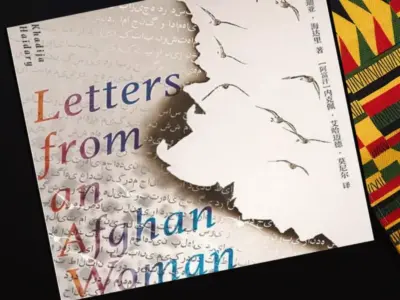
Haidary’s accounts were not abstract statistics; they were lived experiences. She lost her job, male friends, and social life, bearing witness to the daily harassment of women. In China, where civil society is tightly regulated and spontaneous cross-border humanitarian support is rare, her letters, which later evolved into a book titled “A Letter from an Afghan Woman,” sparked an unexpected cross-border solidarity with the oppressed women from far away.
This solidarity did not take the form of a visible movement. Instead, it manifested as quiet, individual acts of support, revealing how empathy adapts under constraint. Chinese readers, moved by Haidary’s words, responded with small gestures of kindness. Some offered financial assistance, while others reached out to provide emotional support. These acts, though seemingly insignificant, were profoundly meaningful to Haidary and other Afghan women facing similar challenges.
The story of Haidary’s writing resonating with Chinese readers highlights the universal human experience of empathy and the ability of individuals to connect across vast distances. In a world often divided by political and cultural boundaries, such cross-border connections remind us of the power of shared humanity. They also underscore the importance of media in bridging gaps and fostering understanding, even in the most constrained environments.
As Haidary’s story unfolds, it serves as a reminder of the resilience of the human spirit and the enduring potential for solidarity. In a time when borders seem to loom larger than ever, her journey offers a glimmer of hope that empathy and connection can transcend even the greatest divides.








