How 1500 Sundarbans Farmers Turned Poisoned Fields Into Farms Growing 192 Rice Varieties
In the spring of 2012, in the West Bengal Sundarbans, Sudhanshu Dey bent down to the soil with a handful of indigenous rice seeds. The Sundarbans had already taught him and his community hard lessons. Every year, cyclones and tidal floods swept across their lands, leaving behind saltwater that poisoned the fields. For four or five years at a stretch, farmers would watch their fields lie barren, their labour unrewarded, their hopes drowned. By 2014, government offices began distributing salt-tolerant rice seeds. They came free of cost, with promises of survival in saline soils. But when the harvests came, the truth was bitter. Yields were poor, the grain lacked taste, and the price in the market did not justify the farmer’s effort. Land lost its value, and families lost their faith. By 2014, government offices began distributing salt-tolerant rice seeds. They came free of cost, with promises of survival in saline soils. Yet, in the corners of villages, farmers had preserved their own indigenous seed varieties, passed down through generations. When sown, these seeds stood tall against the salt. They yielded better, tasted richer, and carried the strength of their ancestors. For Sudhanshu, now 60, that was the turning point. His experiment Determined to test this himself, Sudhanshu filled large plastic pots with soil. He poured five litres of water and mixed in salt bought from the market. Into this, he planted ten local rice varieties. He watched closely to see how much salinity each could endure. “It
In the spring of 2012, in the West Bengal Sundarbans, Sudhanshu Dey bent down to the soil with a handful of indigenous rice seeds. The Sundarbans had already taught him and his community hard lessons. Every year, cyclones and tidal floods swept across their lands, leaving behind saltwater that poisoned the fields. For four or five years at a stretch, farmers would watch their fields lie barren, their labor unrewarded, their hopes drowned. By 2014, government offices began distributing salt-tolerant rice seeds. They came free of cost, with promises of survival in saline soils. But when the harvests came, the truth was bitter. Yields were poor, the grain lacked taste, and the price in the market did not justify the farmer's effort. Land lost its value, and families lost their faith.
Yet, in the corners of villages, farmers had preserved their own indigenous seed varieties, passed down through generations. When sown, these seeds stood tall against the salt. They yielded better, tasted richer, and carried the strength of their ancestors. For Sudhanshu, now 60, that was the turning point. His experiment Determined to test this himself, Sudhanshu filled large plastic pots with soil. He poured five litres of water and mixed in salt bought from the market. Into this, he planted ten local rice varieties. He watched closely to see how much salinity each could endure. "It was a small experiment," he recalls, "but it carried a big dream: to find which native varieties could secure our future."
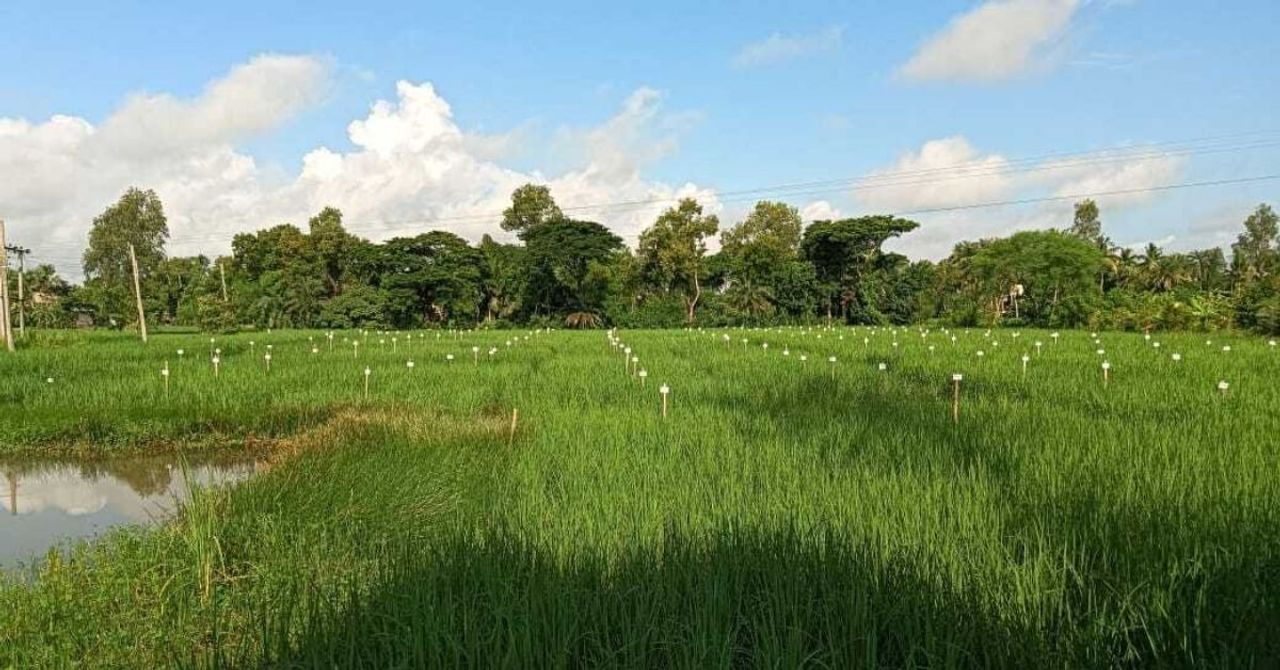
The seed bank From this dream grew the Durbachati Folk Seed Bank in his village of Durbachati. Today, it holds 192 local rice varieties, including several from the state, proudly called "Banglar Dhan" or paddy of Bengal—a place where the Green Revolution nearly wiped out a 5,000-year-old agricultural heritage. Sudhanshu's initiative sparked a movement among 1,500 farmers in the Sundarbans, transforming poisoned fields into thriving farms.
The journey began with a simple question: why did the government-distributed salt-tolerant seeds fail? The answer lay in their genetic makeup. These seeds, bred in laboratories, were designed to withstand salt but lacked the resilience and adaptability of indigenous varieties. Over generations, local seeds had evolved to cope with the unique challenges of the Sundarbans' saline soils, flooding, and cyclones. They were not just crops but living repositories of knowledge, passed down through generations of farmers.
Sudhanshu's experiment revealed that some local varieties could tolerate up to 10% salt concentration, while others thrived even in higher levels. This discovery ignited a renewed interest in preserving these seeds. Farmers began to dig up old seed stores hidden in clay pots, storing them in safe, dry places. They shared their findings, exchanging seeds and knowledge across villages.
Inspired by Sudhanshu's work, the West Bengal government launched a state-of-the-art seed bank in 2016, housing 1,000 indigenous rice varieties. The Durbachati Folk Seed Bank, meanwhile, grew into a hub of biodiversity, attracting researchers and farmers from across India. It became a symbol of resilience, proving that traditional knowledge could offer solutions to modern challenges.
The transformation in the Sundarbans is more than just about rice. It is a testament to the power of community, tradition, and the enduring spirit of farmers. By reconnecting with their ancestral seeds, they have not only saved their livelihoods but also safeguarded a precious heritage. The 192 rice varieties now thriving in the Sundarbans are a tribute to the ingenuity and perseverance of a people who have learned to coexist with nature's fury.
Today, the Sundarbans farmers stand as a beacon of hope for other regions facing similar challenges. Their story underscores the importance of preserving biodiversity and valuing traditional agricultural practices. In a world where industrial agriculture often dominates, the Sundarbans farmers have rediscovered the value of nature's wisdom, turning adversity into abundance. Their fields, once barren and salt-poisoned, now bloom with vibrant life, a testament to the enduring power of the human spirit and the resilience of indigenous knowledge.