
Home ScienceHouston Cheers on Artemis II Moon Mission, Reclaim...
Science⭐ Featured

Houston Cheers on Artemis II Moon Mission, Reclaiming Its Place as ‘Space City’

The Artemis II mission elicited deep feelings for many Americans, particularly in Houston, the home of mission control.
6 April 2026 at 07:58 pm
1 views
Houston Cheers on Artemis II Moon Mission, Reclaiming Its Place as ‘Space City’

Houston, Texas, once again felt the thrill of space exploration as the Artemis II mission soared into the sky, rekindling the city's legacy as the heart of American space endeavors. The city, often referred to as "Space City," has long been synonymous with the United States' space program, and the launch of Artemis II served as a powerful reminder of its enduring significance.

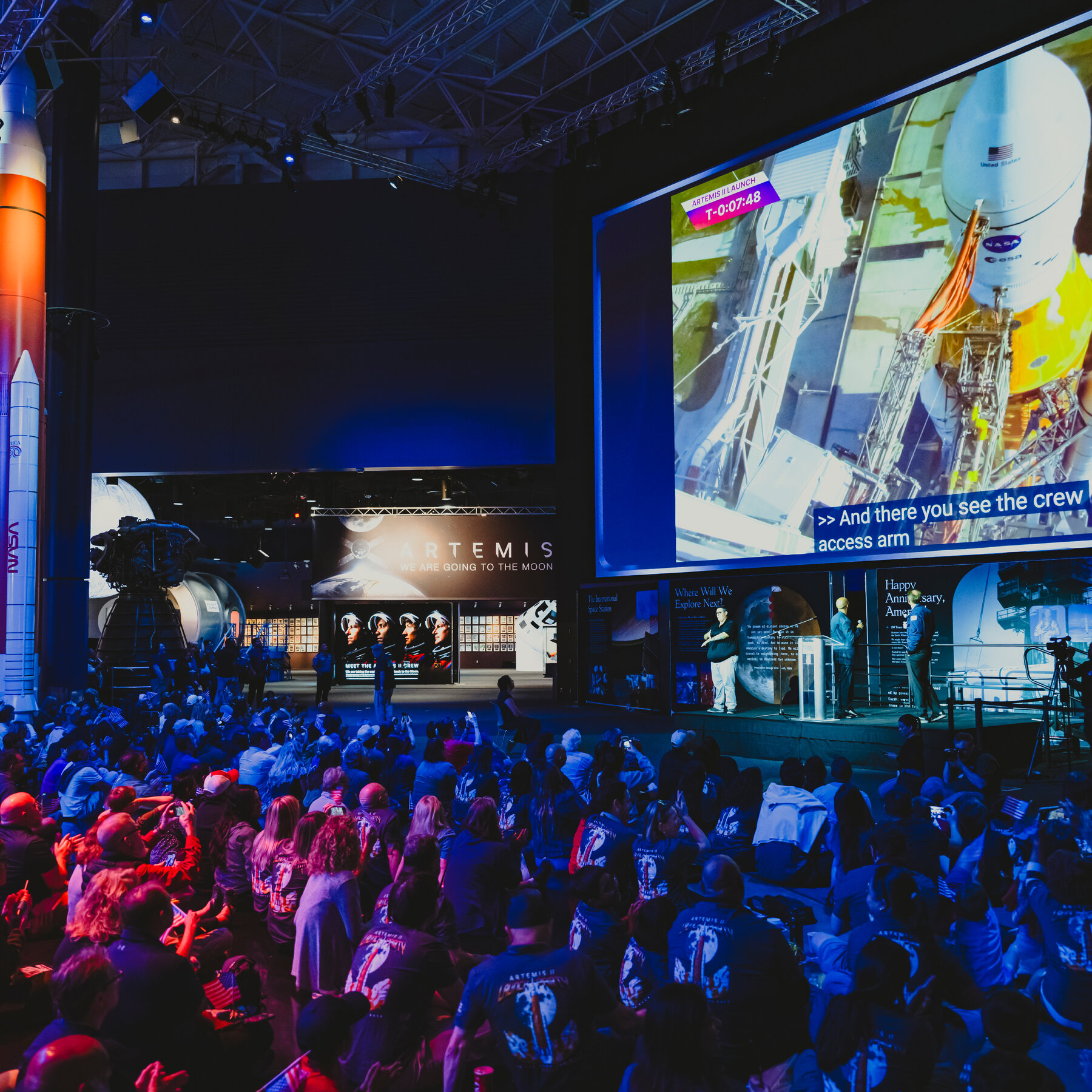
The excitement was palpable as over a thousand enthusiasts gathered at Space Center Houston, eager to witness the historic launch. Families, friends, and space enthusiasts mingled together, united by a shared passion for space exploration. The atmosphere was electric, with anticipation building as the countdown neared its conclusion. Many in the crowd had personal connections to the space program, having worked at NASA or witnessed previous launches, while others were there to celebrate the future of space travel.

The Artemis II mission, a critical step in NASA's plan to return humans to the Moon by 2024, marked a significant milestone for Houston. The city's history with space exploration dates back to the early days of the Apollo program, when mission control operations were established there. Houston has been the nerve center of space missions for decades, and the Artemis II launch underscored its continued role in advancing human spaceflight.

As the rocket ascended into the Texas sky, the crowd erupted in applause and cheers, their voices echoing across the expansive space center grounds. This launch was more than just a technological achievement; it was a celebration of the city's rich heritage and its unwavering commitment to space exploration. Houstonians take great pride in their city's contributions to space science, and the Artemis II mission served as a powerful testament to that legacy.

The launch also highlighted the importance of public engagement in space exploration. In an era where technology and innovation are increasingly central to our lives, the Artemis II mission provided a tangible connection to the future of space travel. The throngs of people at Space Center Houston demonstrated a renewed public interest in space, a testament to the enduring allure of the cosmos.

Moreover, the Artemis II mission has broader implications for Houston's economy and identity. The city has long been a hub for aerospace and technology industries, and the success of this mission could spur further investment and innovation in the region. By reaffirming its status as a leader in space exploration, Houston is poised to attract new businesses and talent, reinforcing its reputation as a global center for scientific and technological advancement.

The Artemis II launch also resonated with a broader audience, inspiring a new generation of space enthusiasts. For many young people, the mission represented a chance to dream big and pursue careers in science, technology, engineering, and mathematics. The city's vibrant space culture, exemplified by the Artemis II mission, serves as a powerful inspiration for aspiring scientists and engineers, encouraging them to pursue their passions and contribute to the future of space exploration.

In the years since the Apollo era, Houston has faced challenges, including the relocation of some NASA operations to other cities. However, the Artemis II mission has reignited the city's passion for space and reaffirmed its central role in America's space program. As the rocket soared into the heavens, Houstonians felt a renewed sense of pride and purpose, eager to continue their city's legacy as a beacon of space exploration.

The Artemis II mission is not just a step forward for NASA; it is a celebration of the enduring spirit of Houston and its unwavering commitment to pushing the boundaries of human achievement. As the city looks to the future, the launch serves as a reminder of the power of collective vision and the importance of investing in the exploration of space. With Artemis II, Houston has reclaimed its place as "Space City," ready to lead the way in the next chapter of space exploration.


📰 Related News
The largest orbital compute cluster is open for business | TechCrunch
Kepler Communications is flying 40 GPUs in Earth orbit. And its latest customer is Sophia Space.
14 Apr
‘Mideast conflict poses risks to Philippines growth’
The Philippine economy is expected to grow at a faster pace of 5.3 percent this year from last year’s 4.4 percent but the ongoing Middle East conflict is seen to pose risks, according to the Association of Southeast Asian Nations Plus 3 Macroeconomic Research Office.
7 Apr
AFBI welcomes DUP representatives to its research farm at Hillsborough
The Agri-Food and Biosciences Institute (AFBI) welcomed a number of DUP representatives to its research farm at Hillsborough on Friday.
7 Apr
A simple way to get more value from metrics
We spent one day 1 building a system that immediately found a mid 7 figure optimization (which ended up shipping). In the first year, we shipped mid 8 figures per year worth of cost savings as a result. The key feature this system introduces is the ability to query metrics data across all hosts and all services and over any period of time (since inception), so we've called it LongTermMetrics (LTM) internally since I like boring, descriptive, names. This got started when I was looking for a starter project that would both help me understand the Twitter infra stack and also have some easily quantifiable value. Andy Wilcox suggested looking at JVM survivor space utilization for some large services. If you're not familiar with what survivor space is, you can think of it as a configurable, fixed-size buffer, in the JVM (at least if you use the GC algorithm that's default at Twitter). At the time, if you looked at a random large services, you'd usually find that either: The buffer was too small, resulting in poor performance, sometimes catastrophically poor when under high load. The buffer was too large, resulting in wasted memory, i.e., wasted money. But instead of looking at random services, there's no fundamental reason that we shouldn't be able to query all services and get a list of which services have room for improvement in their configuration, sorted by performance degradation or cost savings. And if we write that query for JVM survivor space, this also
7 Apr
Accelerating Mathematical and Scientific Discovery with Gemini Deep Think
Research papers point to the growing impact of Deep Think across fields
7 Apr
Gemini 3 Deep Think: Advancing science, research and engineering
Our most specialized reasoning mode is now updated to solve modern science, research and engineering challenges.
7 Apr
Context Engineering for Coding Agents
The number of options we have to configure and enrich a coding agent’s context has exploded over the past few months. Claude Code is leading the charge with innovations in this space, but other coding assistants are quickly following suit. Powerful context engineering is becoming a huge part of the developer experience of these tools. Birgitta Böckeler explains the current state of context configuration features, using Claude Code as an example. more…
7 Apr
What does less protein and nitrogen mean for methane?
Does feeding less protein to cows over a longer period not only reduce nitrogen losses, but also affect methane emissions? Researchers at Wageningen University & Research (WUR) investigated this in a multi-year study with dairy cows, funded by the Vereniging Diervoederonderzoek Nederland (VDN), the Dutch Ministry of Agriculture, Fisheries, Food Security and Nature (LVVN), and […] The post What does less protein and nitrogen mean for methane? appeared first on Agriland.ie .
7 Apr
Second’s Bark Boasts New era of Bitcoin Payments, drawing in former Blockstream developers
Bitcoin Magazine Second’s Bark Boasts New era of Bitcoin Payments, drawing in former Blockstream developers Second, the Bitcoin development lab founded by ex-Blockstream executives including CEO Steven Roose and CTO Erik De Smedt, has unveiled Bark — its custom Ark protocol implementation promising self-custodial payments that are faster and cheaper than Lightning channels. This post Second’s Bark Boasts New era of Bitcoin Payments, drawing in former Blockstream developers first appeared on Bitcoin Magazine and is written by Juan Galt .
7 Apr
'Morale boost': Nasa carries out Moon mission during tough year for science
HOUSTON — As the four Artemis astronauts approached a high point of their lunar mission -- getting slung around the far side of the Moon -- National Aeronautics and Space Administration (Nasa) staffers crowded into Houston's famed mission control room Monday for a team photo.
7 Apr






