Hong Kong Originals: Meet the granny behind Lamma’s half-century iconic dessert stand
As Hong Kong’s economic boom faded and manufacturing moved to China, some long-established, family-run companies preserved their traditions as others innovated to survive. In our new series, HKFP documents the craftsmanship and spirit behind the goods that are still proudly “Made in Hong Kong.” Passing through the winding paths of Lamma Island’s main village of Yung Shue […]
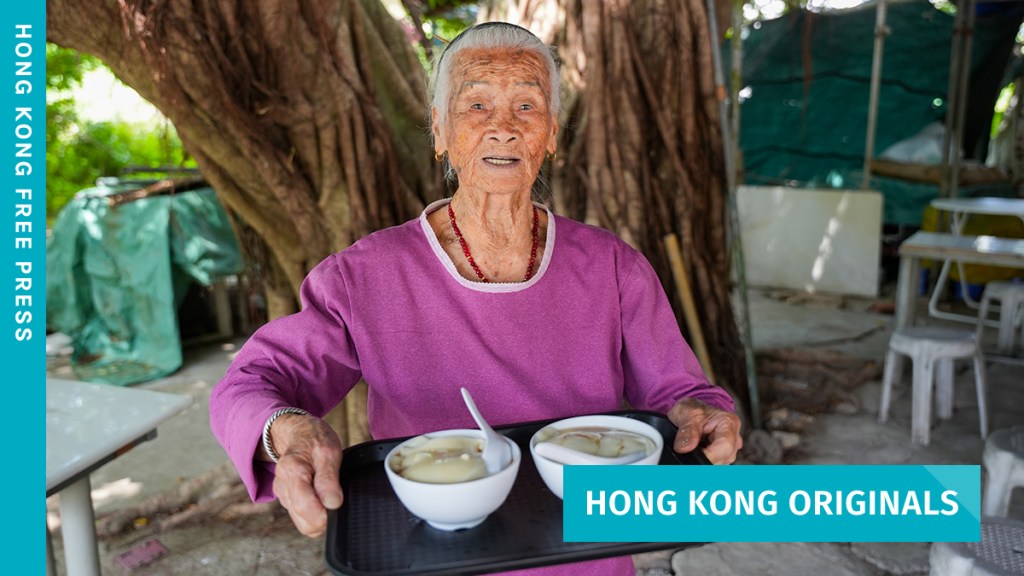
As Hong Kong’s economic boom faded and manufacturing moved to China, some long-established, family-run companies preserved their traditions as others innovated to survive. In our new series, HKFP documents the craftsmanship and spirit behind the goods that are still proudly “Made in Hong Kong.” Passing through the winding paths of Lamma Island’s main village of Yung Shue Wan, which translates as Banyan Bay, day-trippers will arrive at a junction and then a small bridge arching over a stream. There, as they leave the island’s bustling village toward the direction of its serene hills and beaches, is an unmissable tarp-roofed shack selling sweetened silken tofu pudding under the shade of a sprawling banyan tree.
At weekends and on holidays, dozens of people line up in front of the stand for a bowl of tofu fa, a traditional Chinese dessert made from soya beans. The signboard at Grandma Ching’s tofu pudding stand, “Kin Hing Ah Por Tofu Fa,” on Lamma Island on March 24, 2026, reads simply, “Tofu Garden.” Photo: Kyle Lam/HKFP. With cameras at the ready, tourists and vloggers perch over the metal worktop as a small, slender old lady scoops the pudding from a metal pot with a shallow ladle. She fills a bowl to the brim, layer by layer. Then she picks up a large kettle and drenches the tofu pudding in caramel-coloured sweet ginger syrup.
Grandma Ching, or “Ching Por Por” in Cantonese, runs the dessert stand – officially called “Kin Hing Ah Por Tofu Fa” but also known as “Tofu Garden.” The shack, fitted with assorted plastic tables and stools as well as a large round mahogany table, has been a fixture on Lamma Island for almost half a century. Grandma Ching reckons she is 92 years old, but she is not entirely sure. She was born in the 1930s in a village on the mainland, and her family moved to Hong Kong when she was a child. She learned to make tofu fa from her mother, who had been making it for generations.
“When I was young, we didn’t have much money,” Grandma Ching recalls, her eyes twinkling with nostalgia. “But my mother always made tofu fa for special occasions. It was a comforting dish, and it reminded us of home.” As she grew older, Grandma Ching decided to make tofu fa her life’s work. In the 1970s, she opened her stand on Lamma Island, which was then a quiet, rural getaway for Hong Kongers seeking respite from the city. The island’s natural beauty and the simplicity of the tofu fa resonated with visitors, and the stand quickly became a beloved local institution.
Over the years, Grandma Ching’s tofu fa has become synonymous with Lamma Island. The dessert’s popularity has grown, attracting food enthusiasts and tourists from around the world. Yet, Grandma Ching remains humble, attributing her success to the simple, time-honored recipe and the dedication of her family. Her son and daughter-in-law occasionally help run the stand, but Grandma Ching insists on making the tofu fa herself, using the same techniques she learned from her mother.
“The secret to good tofu fa is patience and care,” Grandma Ching explains, her hands deftly scooping the pudding into bowls. “You have to let the soya beans soak for hours, and then slowly cook them until they become silky. And the ginger syrup – it needs to be just the right consistency, not too thick or too runny.” As she pours the syrup over the tofu pudding, the aroma of ginger and caramel wafts through the air, enticing passersby.
Despite the changing times, Grandma Ching’s stand remains a testament to the enduring appeal of tradition. In an era when many Hong Kong businesses have struggled to adapt, her tofu fa has become a symbol of resilience and heritage. Visitors to Lamma Island often leave with a bowl of tofu fa in hand, savoring the taste of a bygone era. And for Grandma Ching, it’s not just a business – it’s a way of life, a connection to her roots, and a tribute to the generations who came before her.
As the sun sets over Lamma Island, Grandma Ching locks up her stand, her day’s work done. But her legacy lives on, in every bowl of tofu fa served to those who seek a taste of Hong Kong’s rich culinary heritage. And for now, at least, the tarp-roofed shack under the banyan tree will remain a staple of the island, a beacon of tradition in a rapidly changing world.