Galileo and His ‘six long meetings’ with Urban VIII in 1624
.
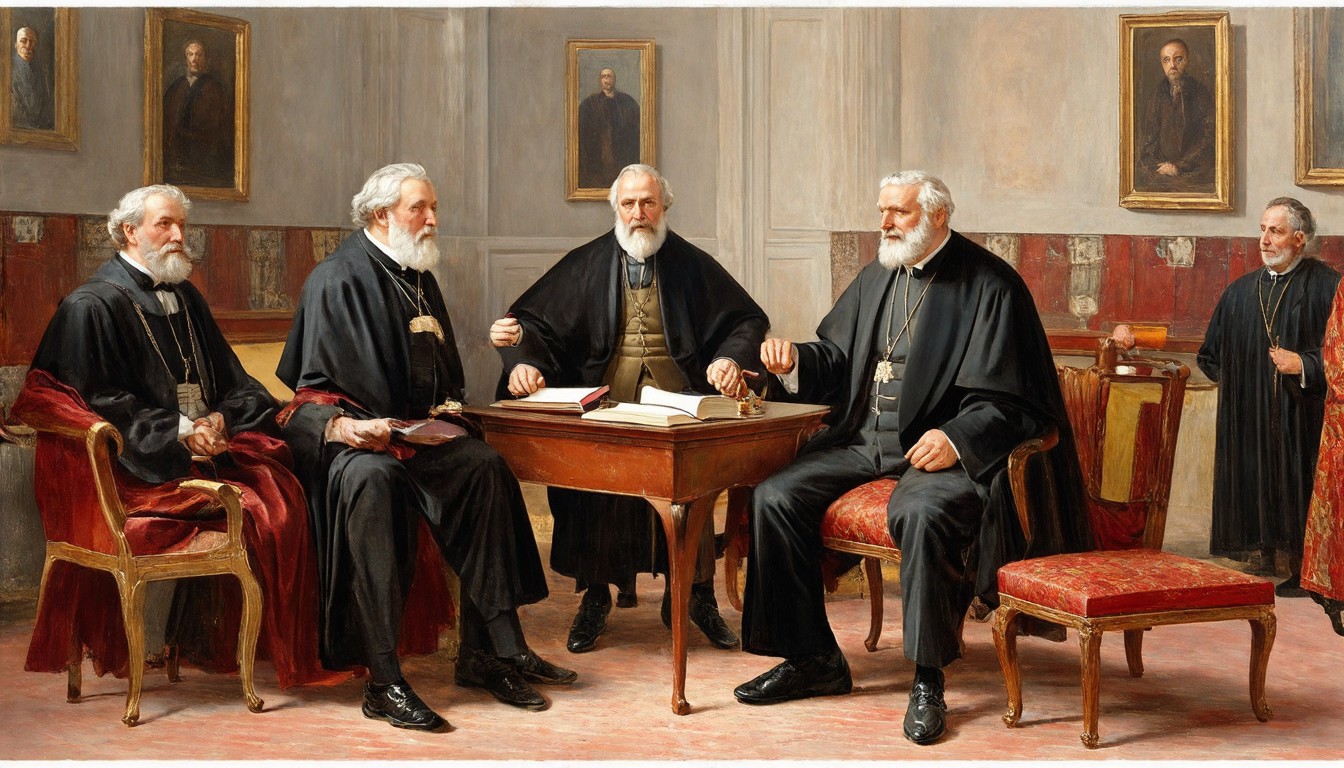
In 1624, the world of astronomy and the Catholic Church found themselves entwined in a complex web of tension and diplomacy, as Galileo Galilei faced a series of pivotal meetings with Pope Urban VIII. These encounters, later referred to as Galileo's "six long meetings," were a critical moment in the history of science and religion, highlighting the challenges of reconciling new discoveries with established doctrines.
Galileo, a renowned astronomer and physicist, had gained significant attention for his support of the heliocentric model of the solar system, which posited that the Earth and other planets revolved around the Sun. This theory, championed by Nicolaus Copernicus, challenged the long-held geocentric view endorsed by the Church, which held that Earth was the center of the universe. Galileo's observations, particularly his use of the telescope to discover the moons of Jupiter and the phases of Venus, provided compelling evidence in favor of the heliocentric model. However, these findings also threatened the Church's authority, as they contradicted certain interpretations of scripture.
Pope Urban VIII, who had initially been supportive of Galileo's work, began to see the heliocentric theory as a threat to the Church's teachings. In 1616, the Church had issued a decree condemning the Copernican system, and Galileo was warned to abandon his support for it. Despite this, Galileo continued to advocate for the heliocentric model, leading to increasing tensions between him and the Church.
In 1624, Pope Urban VIII summoned Galileo to Rome for a series of meetings, ostensibly to discuss the publication of Galileo's major work, "Dialogue Concerning the Two Chief World Systems." The "Dialogue" presented arguments for and against the heliocentric model, with Galileo's own sympathies evident in its pages. However, Urban VIII viewed the work as a direct challenge to Church doctrine and sought to prevent its publication.
The six meetings between Galileo and Pope Urban VIII were fraught with tension and diplomacy. Urban VIII, a scholar in his own right, engaged Galileo in intellectual debates, attempting to persuade him to abandon his views. Galileo, however, remained steadfast in his convictions, arguing that scientific inquiry should be guided by empirical evidence rather than dogma.
During these meetings, Urban VIII attempted to broker a compromise. He suggested that Galileo could present the heliocentric model as a mere hypothesis, acknowledging its limitations and the possibility of error. In return, the Pope promised to protect Galileo from further persecution and to support his scientific endeavors. However, Galileo refused to compromise, insisting that the evidence for the heliocentric model was irrefutable and that it should be accepted as a fact.
The meetings concluded without a resolution, leaving both parties frustrated. Urban VIII, disappointed by Galileo's intransigence, eventually banned the "Dialogue" and ordered Galileo to recant his support for the heliocentric model. Galileo, though forced into house arrest, never formally recanted his beliefs, maintaining his stance that the evidence for the heliocentric system was overwhelming.
The six long meetings between Galileo and Pope Urban VIII in 1624 marked a turning point in the relationship between science and religion. They underscored the challenges of reconciling new scientific discoveries with established religious doctrines and highlighted the personal and professional sacrifices that scientists often faced in pursuit of knowledge. The legacy of these meetings continues to resonate in contemporary debates about the intersection of science and faith, serving as a reminder of the enduring tension between empirical inquiry and dogma.