From Ashaval to Karnavati to Ahmedabad: How Ahmad Shah Islamised Karna Dev Solanki’s great city—the story of conquest, renaming, and a city’s changing identity
The Gujarat Vishwa Hindu Parishad (VHP) has appealed to the state government and the central government to immediately change the name of Ahmedabad to Karnavati.
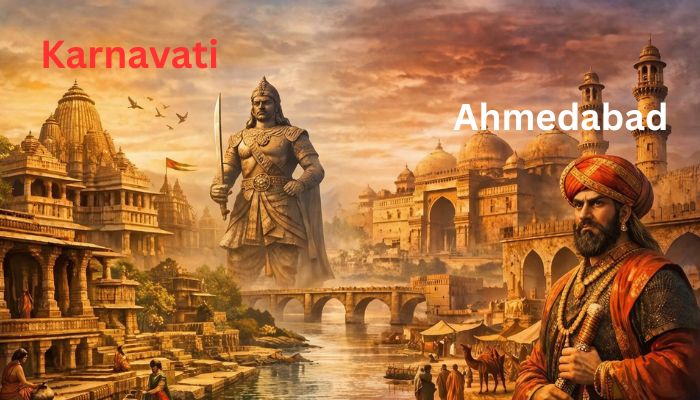
The demand to change the name of Ahmedabad, the economic capital and largest city of Gujarat, to its original name "Karnavati" has been raised repeatedly. In the past, there have been discussions about changing the name of the city many times, and campaigns have also been carried out from time to time. Hindu organisations have also been demanding that the name of the city be changed to Karnavati from time to time. Now the same demand has been raised once again. The Gujarat Vishwa Hindu Parishad (VHP) has appealed to the state and central governments to immediately change Ahmedabad's name to Karnavati.
VHP Gujarat leader Ashok Rawal made this demand through a video statement on Saturday, 4th April. In a video posted on the Facebook page of VHP Karnavati Mahanagar, he said, "The name Karnavati is linked to our glorious history and culture. This is not just a name but a symbol of the identity and tradition of our ancestors. Today's Ahmedabad city has been known as Karnavati for centuries. We humbly appeal to the Government of India and the Government of Gujarat to immediately change the original name of the city to 'Karnavati', respecting the sentiments of crores of citizens."
This statement has come to the fore soon after the announcement of local elections, and the demands of the Hindu organisation have also intensified. In this scenario, it becomes very important to know the history of the name of the city. Because this city was earlier known as Ashaval, Karnavati, and Rajnagar. Its last name was Karnavati; it was called "Rajnagar" in many Jain texts. But from the 14th century, the city was renamed Ahmedabad by Ahmad Shah I, the Sultan of Gujarat.
Ahmad Shah I, a Muslim ruler, conquered the city in 1407 after defeating the Solanki king Karna Dev. The city was renamed Ahmedabad in honor of the Sultan's son, Ahmad Shah II. The name change was part of a broader effort to assert the new ruler's authority and erase the previous dynasty's legacy. However, the city's original name, Karnavati, was derived from the name of the Solanki king Karna Dev, who had ruled the region before the Muslim conquest.
The demand to revert the city's name to Karnavati is rooted in the desire to reclaim the city's Hindu heritage and to assert its historical significance. The VHP and other Hindu organisations argue that the name change was a forced imposition by the Muslim rulers and that the city's true identity lies in its original name. They believe that restoring the name would help in preserving the city's cultural and historical continuity.
The call for changing the city's name has gained momentum in recent years, particularly as tensions between Hindus and Muslims in India have heightened. The demand has also been seen as a political tool, with the Bharatiya Janata Party (BJP) using it to appeal to its Hindu nationalist base ahead of the upcoming local elections in Gujarat.
However, the issue of changing the city's name is not without controversy. Critics argue that it would only serve to deepen communal divisions and could be seen as an attempt to erase the city's Muslim heritage. They also point out that the name Ahmedabad has become synonymous with the city and is deeply ingrained in its identity.
The central and state governments have not yet responded to the VHP's demand. The issue will likely be debated in the upcoming local elections, with political parties expected to take sides. The city's changing identity, shaped by centuries of conquest, renaming, and cultural exchange, continues to be a point of contention and a subject of intense debate.
In conclusion, the demand to change Ahmedabad's name to Karnavati is a reflection of the city's complex history and the ongoing struggle to define its identity. It highlights the tensions between different communities and the efforts to reclaim historical narratives. As the city prepares for local elections, the debate over its name is likely to become a significant political issue, shaping the course of the upcoming civic battle.