
Could lightning occur on Mars?
MAVEN probe captures signature of a "whistler" The post Could lightning occur on Mars? appeared first on Physics World .
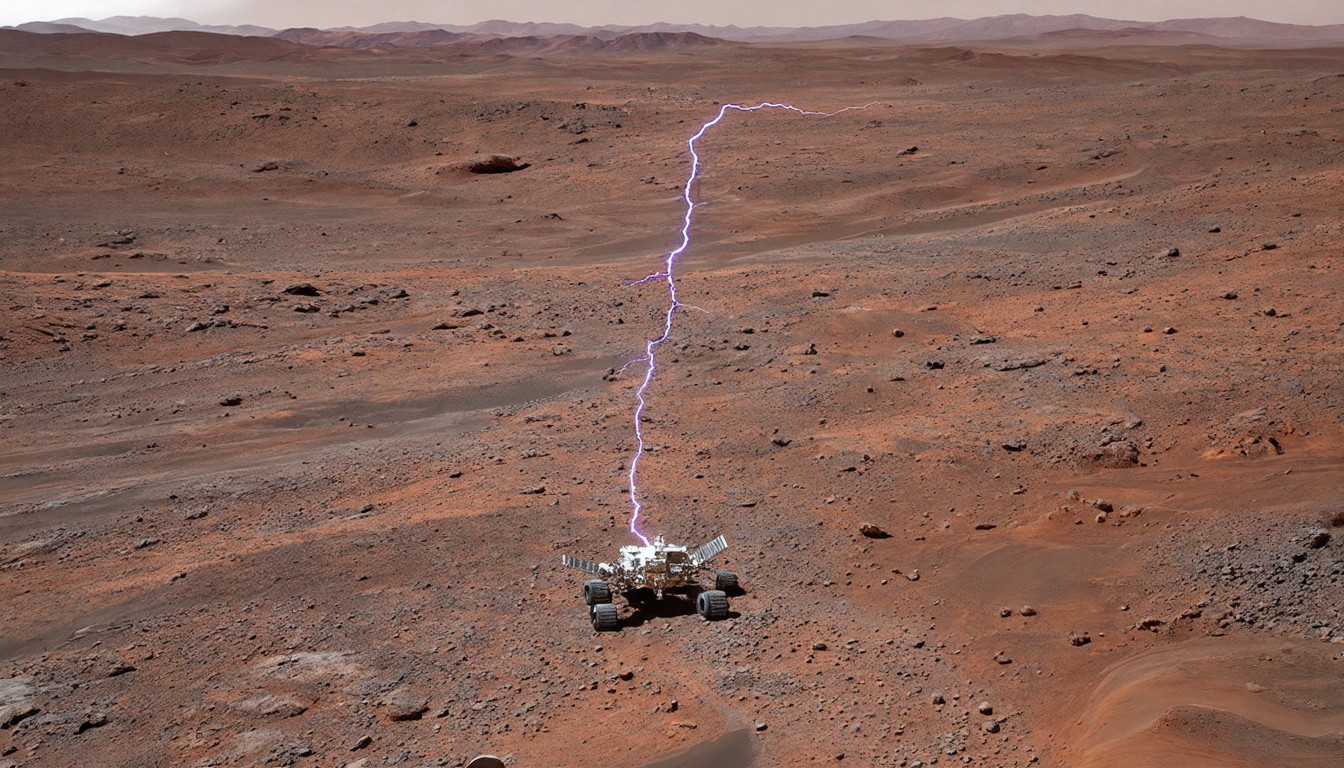
The possibility of lightning occurring on Mars has captured the attention of scientists after a recent discovery by researchers in the Czech Republic. They claim to have observed the signature of a "whistler" in a one-second snapshot captured by the MAVEN (Mars Atmosphere and Volatile Evolution) probe orbiting the planet. This event, observed in the ionosphere of Mars, would be the first lightning-like electric discharge activity ever to be seen there, and the finding is significant for understanding atmospheric processes in the Martian atmosphere.
Space physicist František Němec, leading the research effort at Charles University, explains that "whistlers are well known on Earth and are associated with lightning." The discovery implies that this phenomenon also occurs on Mars, our planetary neighbor. Unlike Earth, Mars does not have a global magnetic field but only localized fields created by magnetized materials in the planet's crust. Additionally, Mars has a thin atmosphere, which means that lightning, if it occurs, does not originate in water clouds but instead in dust storms, similar to those observed in volcanic eruptions on Earth and in dust devils.
During dust storms, dust grains become electrically charged as they collide with each other and generate an electric field. Previous studies have predicted that this field can discharge when its value exceeds the breakdown threshold in the low-pressure Martian atmosphere, which is around 15 kV/m. Dust devils, for their part, can produce ultralow-frequency radiation on Earth due to the electrical charges that fluctuate as the dust swirls around. Since both dust devils and dust storms are much stronger on Mars, theory suggests that they could generate wideband radiation that we could detect on Earth.
Despite recent measurements by the Allen Telescope Array, the Mars Global Surveyor (MGS), the MAVEN missions, and the Mars Express spacecraft, conclusive evidence for Martian lightning has yet to be found. František Němec suggests that another way to detect these electric discharges is by analyzing the electromagnetic radiation they produce. The MAVEN probe's observation of the whistler signature provides a potential breakthrough in this area, offering a new perspective on the atmospheric dynamics of Mars.
The detection of whistlers on Mars is a significant step forward in understanding the planet's atmospheric processes. While the presence of lightning-like activity was previously theorized, this is the first observational evidence. The findings could also have implications for the potential habitability of Mars, as they provide insights into the planet's atmospheric behavior and the potential for electrical phenomena that could impact the surface and any potential future missions.
In conclusion, the MAVEN probe's capture of a whistler signature in Mars' ionosphere marks a potential turning point in the search for lightning on the planet. This discovery, led by Czech researchers, not only challenges previous assumptions about the absence of lightning on Mars but also opens new avenues for studying the Martian atmosphere. As further research continues, it is likely that our understanding of the planet's atmospheric processes will be significantly enhanced, shedding light on the unique characteristics of Mars and its potential for hosting electrical discharges.








