CIMMYT and partners launch Ethiopia’s Fertilizer and Soil Health RoadMap to restore degraded soils and boost food security
What to read next: CIMMYT and partners are turning farms into futures for Ethiopia’s young people | Excellence in Agronomy Initiative commences in Africa | Ethiopia’s Experience of Wheat Production Exemplary to African Countries: CIMMYT | A blueprint for soil health initiatives
Ethiopia has taken a significant step toward restoring soil health and enhancing national food security with the launch of its Fertilizer and Soil Health RoadMap. Developed in partnership with the International Maize and Wheat Improvement Center (CIMMYT) and other key stakeholders, the RoadMap offers a comprehensive strategic framework to address soil degradation, promote balanced nutrient management, improve fertilizer use-efficiency, and guide targeted investments aimed at restoring productivity and resilience across the country’s agricultural landscapes.
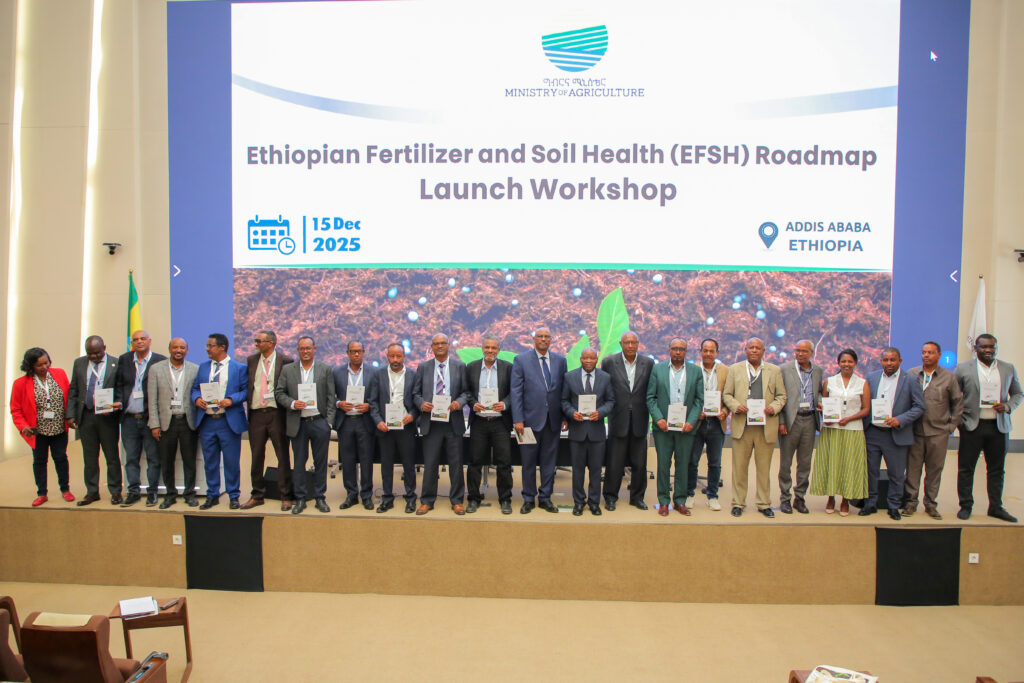
The initiative was officially inaugurated in Addis Ababa, with participants gathering for a group photo following the ceremony. Ethiopian State Minister at the Ministry of Agriculture, H.E. Prof. Eyasu Elias, emphasized the importance of soil health as the foundation of Ethiopia’s food systems and rural economy. He highlighted that the RoadMap provides a coordinated national framework to rehabilitate degraded soils, improve fertilizer management, and ensure sustainable agricultural growth for future generations.
Soil degradation is a critical national challenge in Ethiopia, affecting 41% of cultivated land. This issue is compounded by soil acidity, nutrient depletion, land degradation, alkalinity, sodicity, and declining organic matter. Climate change, unsustainable land management practices, and limited adoption of improved soil management technologies further exacerbate these problems. The economic consequences are substantial, with annual agricultural production and ecosystem services losses estimated between USD 1 billion and USD 4.3 billion. In the highlands alone, annual grain losses are estimated at 1.5 million tons, equivalent to approximately 2% to 6.75% of the national agricultural GDP.
The Fertilizer and Soil Health RoadMap aims to address these challenges by providing a roadmap for soil health initiatives. It focuses on rehabilitating degraded soils, improving fertilizer management, and ensuring sustainable agricultural growth. The RoadMap is a collaborative effort between the Ministry of Agriculture and CIMMYT, alongside other key stakeholders. This partnership is crucial in developing and implementing strategies to restore soil health and boost food security in Ethiopia.
The RoadMap also highlights the importance of promoting balanced nutrient management and improving fertilizer use-efficiency. By optimizing fertilizer application and ensuring sustainable practices, the initiative aims to enhance agricultural productivity and reduce the negative impacts of soil degradation. Additionally, the RoadMap guides targeted investments to restore soil productivity and resilience, ensuring long-term agricultural growth and food security for the country.
The launch of the Fertilizer and Soil Health RoadMap is a significant milestone in Ethiopia’s efforts to address soil degradation and improve food security. With the support of CIMMYT and other partners, the country is well-positioned to implement effective soil health strategies and foster sustainable agricultural development. This initiative not only addresses immediate challenges but also lays the foundation for future generations to benefit from healthier soils and more resilient agricultural systems.
The RoadMap’s success will depend on the coordinated efforts of various stakeholders, including government agencies, farmers, researchers, and private sector partners. By working together, they can develop and implement innovative solutions to restore degraded soils, improve fertilizer management, and ensure sustainable agricultural growth. The Ethiopian government’s commitment to soil health is a testament to its dedication to addressing food security and promoting economic development through agriculture.
In conclusion, the launch of Ethiopia’s Fertilizer and Soil Health RoadMap marks a pivotal moment in the country’s journey toward restoring soil health and enhancing food security. With the support of CIMMYT and other key partners, Ethiopia is poised to implement a comprehensive strategy that addresses soil degradation, promotes balanced nutrient management, and ensures sustainable agricultural growth. This initiative not only tackles immediate challenges but also lays the groundwork for long-term agricultural resilience and economic prosperity.