Home EducationChina Experimental Research Station have developed...
Education

China Experimental Research Station have developed a technique that can transform barren desert sand into fertile, plant supporting soil in just 10 months.

In a major breakthrough against desertification, researchers at Shapotou Desert Experimental Research Station have developed a technique that can transform barren desert sand into fertile, plant-supporting soil in just 10 months.
28 May 2026 at 02:48 pm
4 views
China Experimental Research Station have developed a technique that can transform barren desert sand into fertile, plant supporting soil in just 10 months.

Hey yaar, you know how we usually hear depressing news about the desert swallowing up farmland and expanding every year? Well, researchers have just flipped the script. Instead of just planting trees in the sand and hoping for the best, Chinese scientists have figured out a way to literally turn shifting, dead desert sand into stable, fertile soil.

The craziest part? They are doing it in just 10 to 16 months using one of the oldest living things on the planet. Here is a breakdown of what could be the biggest ecological breakthrough weтАЩve seen in a long time.

The Problem: Why Traditional Methods Fall Short Desertification is a massive global crisis. In places like China's Taklamakan and Tengger deserts, expanding sands threaten infrastructure, swallow villages, and trigger massive dust storms that choke cities hundreds of miles away. The old-school way to fight this was building massive checkerboards out of straw or trying to manually plant millions of trees. But trees need waterтАФwhich deserts obviously lackтАФand they need stable soil to anchor their roots. If a harsh gust of wind blows the sand away, the plants just die. Scientists realized they needed a way to lock the sand down first before complex plant life could ever survive.

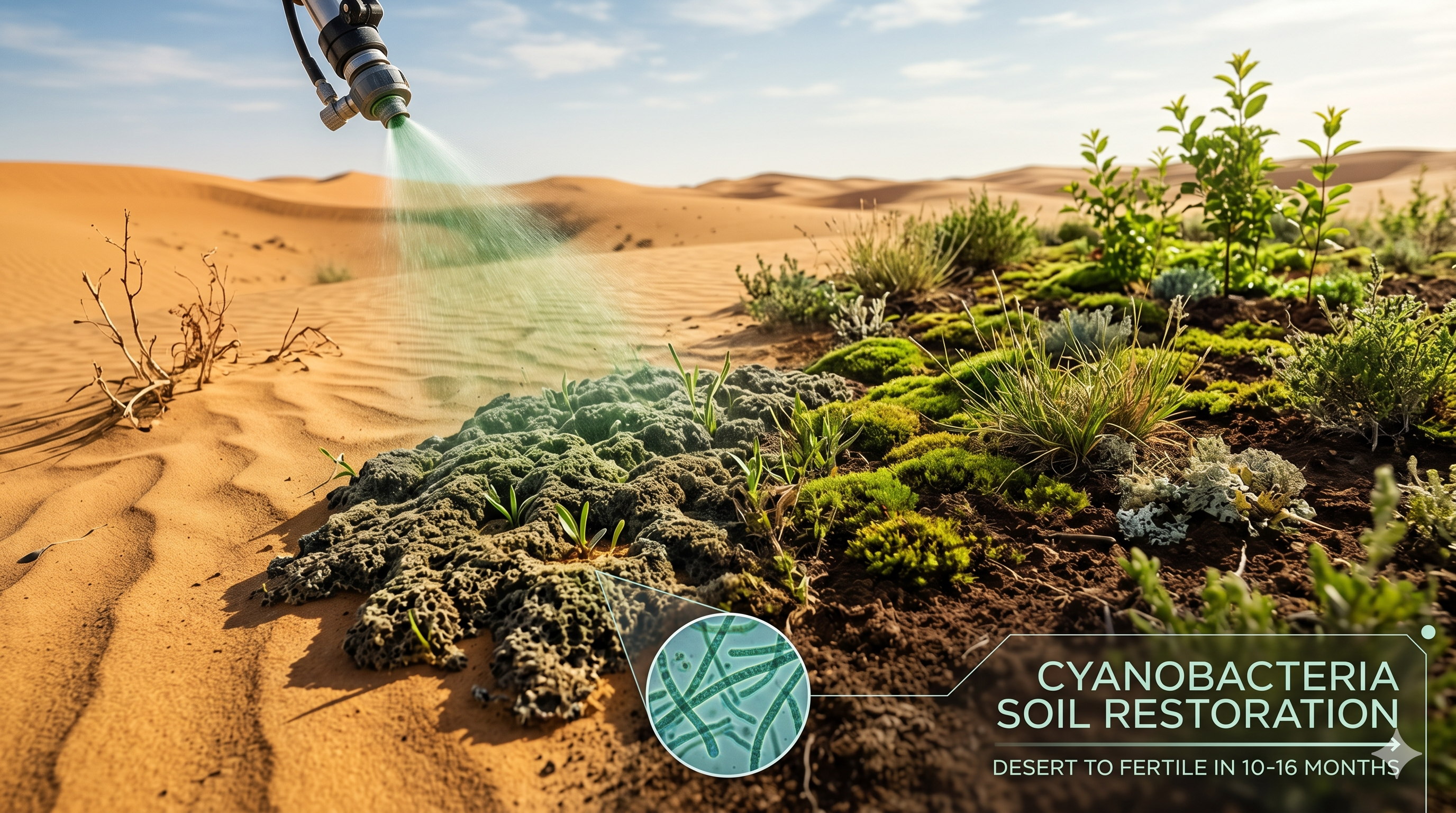
Enter the "Bio-Glue": Cyanobacteria This is where researchers at the Shapotou Desert Experimental Research Station (under the Chinese Academy of Sciences) got brilliant. They turned to cyanobacteriaтАФancient, microscopic organisms that run on sunlight and can survive some of the most extreme heat and drought conditions on Earth. Here is how the process works: Researchers take native, drought-resistant strains of these microbes, grow them in a lab, and then spray them directly onto the barren dunes. Once the dormant bacteria get even a tiny bit of moisture (like morning dew), they wake up and multiply rapidly. As they grow, they secrete sticky, sugar-based substancesтАФessentially a natural "bio-glue."

This microscopic glue coats the loose silica grains and binds them tightly together, forming a hardened, living skin over the desert called a Biological Soil Crust (BSC). Why This is an Absolute Game-ChangerThis living crust completely changes the environment, and it does three incredible things very quickly:It Stops Wind Erosion: Lab tests show this bio-crust cuts wind-driven soil loss by over 90%. The sand simply stops blowing away, meaning fewer dust storms.

It Acts Like a Sponge: Bare sand drains water instantly. The crust, however, traps moisture right at the surface where future plants will need it most. It Generates Free Fertilizer: Some strains of these cyanobacteria literally pull nitrogen straight from the air and convert it into plant-ready nutrients (ammonia and nitrates). As the microbes live and die, they trap organic carbon, transforming sterile sand into a nutrient-rich foundation. In nature, building a mature biological crust like this takes anywhere from 15 to 50 years. By culturing the bacteria and spraying it in high concentrations, scientists have compressed decades of natural ecological recovery into just 10 to 16 months! Once that crust is established, it paves the way for lichens, moss, and eventually tough desert grasses to naturally take root without human intervention.

The Catch Of course, itтАЩs not a flawless miracle cure. While the bacterial crust is incredibly tough against heat and drought, it is physically fragile. If an off-road truck drives over it, or a dense herd of grazing sheep tramples it, the crust shatters. Once broken, the loose sand underneath is exposed to the wind all over again. So, you can't just spray it and walk awayтАФthe land has to be strictly protected from human and animal traffic while the deeper-rooted plants take hold.

Source: Economic
ЁЯУ░ Related News
Rising costs тАШcripplingтАЩ most farming sectors in NI тАУ FFA
The steering committee of Farmers For Action (FFA) has said that rising fuel, fertiliser, and other costs are now тАЬcripplingтАЭ most farming sectors in Northern Ireland. The organisation also said that тАЬabysmal” farm gate prices are тАЬbreaking the camelтАЩs backтАЭ. The FFA said the Department of Agriculture, Environment and Rural Affairs (DAERA) is “making things […] The post Rising costs тАШcripplingтАЩ most farming sectors in NI – FFA appeared first on Agriland.ie .
7 Apr
Weather: Strong winds over the weekend and staying unsettled
The weather this Easter weekend will see strong winds as Storm Dave hits Ireland, and it is set to remain unsettled after that into next week, according to Met ├Йireann. A Status Yellow warning has been issued for the whole country. This warning will come into effect at 2:00p.m tomorrow afternoon (Saturday, April 4) and […] The post Weather: Strong winds over the weekend and staying unsettled appeared first on Agriland.ie .
7 Apr
Announcing the AWS Sustainability console: Programmatic access, configurable CSV reports, and Scope 1тАУ3 reporting in one place
AWS announces the Sustainability console, a new standalone service that consolidates carbon emissions reporting and resources, giving sustainability teams independent access to Scope 1, 2, and 3 emissions data without requiring billing permissions.
7 Apr
Spring grazing: Risk of negative energy balance
Unsettled weather means spring grazing is still quite messy, but its important to push on as the risk of negative energy balances (NEB) rise. NEB is often an issue at this stage, as much of the herd begins to reach their peak milk production but have not yet reached their maximum dry matter intake (DMI). […] The post Spring grazing: Risk of negative energy balance appeared first on Agriland.ie .
7 Apr
Raising the bar: Celebrating the best of West CorkтАЩs dairy farming
At a time when dairy farming is under intense scrutiny, itтАЩs easy to lose sight of what is actually happening on farms across west Co. Cork. Behind the headlines and debates, thousands of family farmers are quietly producing some of the highest-quality, lowest-carbon milk in Europe – while continuing to protect their land, their animals […] The post Raising the bar: Celebrating the best of West CorkтАЩs dairy farming appeared first on Agriland.ie .
7 Apr
How has the wet spring affected feed costs?
We are now in April and yet a good number of herds have very little of the platform grazed, while others still have not seen any grass in 2026 due to the weather. To make matters worse, Met ├Йireann is still predicting two to three times more than the average rainfall for the week ahead. […] The post How has the wet spring affected feed costs? appeared first on Agriland.ie .
7 Apr
Most Irish dairy cows moved to sheds in March тАУ survey
The majority of Irish dairy farmers have returned their cattle to sheds in some form due to the wet weather experienced recently, a new survey has found. This is based on the latest Calving Insights Survey conducted by FRS Co-Op for the month of March. The survey found that, despite some spells of dry weather […] The post Most Irish dairy cows moved to sheds in March тАУ survey appeared first on Agriland.ie .
7 Apr
Opinion: Easter has always been a true celebration of Irish sheep production
Easter has always been synonymous with all that is good about Irish sheep production. And long may this continue to be the case. Spring-born lambs gambolling in fields always epitomise the ending of winter and the promise of better weather to come. ItтАЩs just a pity that the spring of 2026 has not lived up […] The post Opinion: Easter has always been a true celebration of Irish sheep production appeared first on Agriland.ie .
7 Apr
The basics of irrigation during hot weather
Hot, dry conditions test even the best irrigation strategies. Christo van der Westhuizen, agronomist at Netafim Southern and East Africa, explained to Glenneis Kriel how farmers can manage water efficiently to protect crops during hot days.
7 Apr
Cold Weather Vegetables: Why Cold Makes Some Crops Sweet
Cold weather vegetables and other late-season crops are known to see a marked taste improvement after a light frost or two. For the best-tasting apples, leafy greens, and root crops, a dousing of cold weather can be just the ticket. This is true not only for fall harvests, but also for early spring crops that […] The post Cold Weather Vegetables: Why Cold Makes Some Crops Sweet appeared first on Hobby Farms .
7 Apr