‘Business as usual’: Why some Hongkongers are staying in Middle East despite conflict
As the United Arab Emirates (UAE) and other Gulf states were targeted by Iranian airstrikes, Hongkonger Oi Chau joined a chorus of other expats saying it was “business as usual” in Dubai. She was convinced after seeing images of UAE President Sheikh Mohamed bin Zayed Al Nahyan and Dubai Crown Prince Sheikh Hamdan bin Mohammed […]
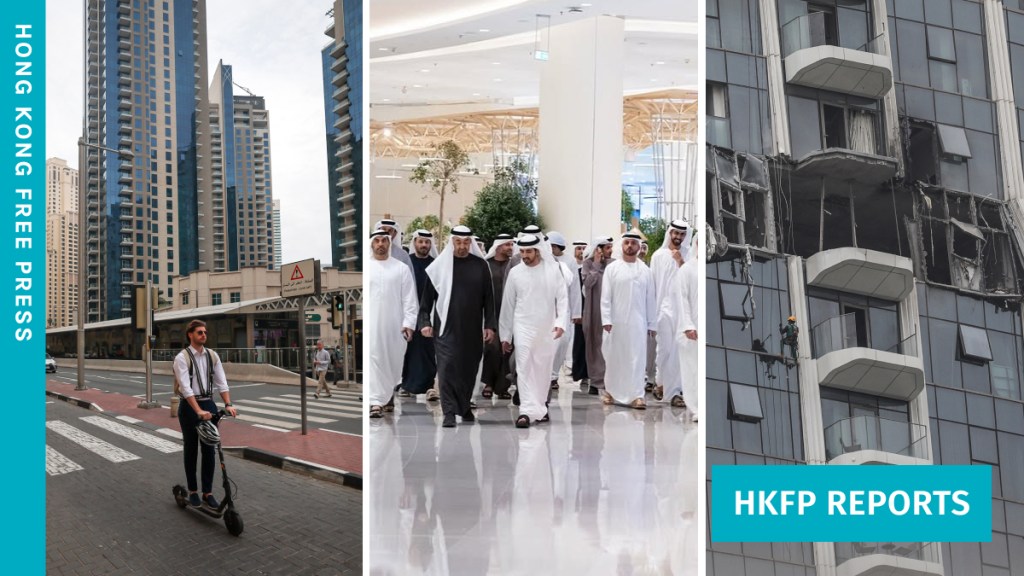
As the United Arab Emirates (UAE) and other Gulf states faced Iranian airstrikes, Hongkonger Oi Chau found herself among a group of expats who insisted that life in Dubai remained unchanged. Dubai’s leaders, including UAE President Sheikh Mohamed bin Zayed Al Nahyan and Dubai Crown Prince Sheikh Hamdan bin Mohammed bin Rashid Al Maktoum, who also serves as defence minister, helped reinforce this perception. Images of the leaders strolling around Dubai Mall on March 2, just two days after the US-Israeli attacks on Iran triggered a military conflict in the Middle East, captured the public’s attention.
Four weeks later, on March 23, Sheikh Hamdan made another visit to the same mall, this time accompanied by Finance Minister Sheikh Maktoum bin Mohammed bin Rashid Al Maktoum. For Oi Chau and others, it seemed as though nothing had changed. “It was as if nothing happened, as if it was business as usual,” Chau told HKFP.
The UAE, a regional economic superpower that hosts US military assets, has borne the brunt of Iranian strikes. By March 23, UAE air defences had intercepted 438 ballistic missiles, 19 cruise missiles, and 2,012 drones launched by Tehran. The Ministry of Defence reported that 12 people had been killed, with nine of them being foreign nationals, and 190 others injured.
Despite these developments, the Hong Kong government raised travel alerts for countries in the Middle East, including the UAE and Saudi Arabia. The alert came as about 590 out of 830 Hong Kong residents who had sent enquiries to the Immigration Department had left the region, while 240 remained behind in the UAE, Qatar, and Saudi Arabia.
Oi Chau, like many Hongkongers, is accustomed to the insularity of their home city from armed conflicts. However, she chose to stay in Dubai, joining others who prioritized their livelihoods and daily routines over the uncertainty of the war.
Chau recalled hearing the initial strikes on February 28 from her flat in the Dubai Marina district. Located just a 30-minute drive away from the Port of Dubai, she was in a position to witness firsthand the resilience of the city. Despite the ongoing conflict, life in Dubai continued as usual. Shopping malls, restaurants, and other public spaces remained open, and the city’s infrastructure functioned without significant disruption.
The UAE’s leaders have played a crucial role in maintaining this sense of normalcy. Their public appearances, such as the visits to Dubai Mall, served as a reassurance to both locals and expats that the country was secure and stable. This, combined with the robust security measures in place, has helped to allay fears and keep businesses operating.
For Hongkongers like Oi Chau, the decision to stay in the Middle East was not taken lightly. The region’s history of political unrest and the recent escalation of tensions in the Middle East have understandably raised concerns. However, the economic opportunities and quality of life in Dubai have proven to be compelling factors for many.
The Hong Kong government’s travel alert, while acknowledging the risks, has not deterred all residents from staying in the region. Some have chosen to remain in the UAE, Qatar, and Saudi Arabia, relying on the countries’ robust security infrastructure and the UAE’s leadership in maintaining stability amid the conflict.
In the end, the decision to stay or leave often comes down to personal circumstances and perceptions of safety. For Oi Chau and others who have chosen to remain in the Middle East, the sense of normalcy and the continued operation of daily life have outweighed the uncertainties of the ongoing conflict. As they navigate this complex situation, the resilience of Dubai and the leadership of its leaders serve as a testament to the enduring allure of the region for both locals and expats alike.