
‘Business as usual’: Why some Hongkongers are staying in Middle East despite conflict
As the United Arab Emirates (UAE) and other Gulf states were targeted by Iranian airstrikes, Hongkonger Oi Chau joined a chorus of other expats saying it was “business as usual” in Dubai. She was convinced after seeing images of UAE President Sheikh Mohamed bin Zayed Al Nahyan and Dubai Crown Prince Sheikh Hamdan bin Mohammed […]
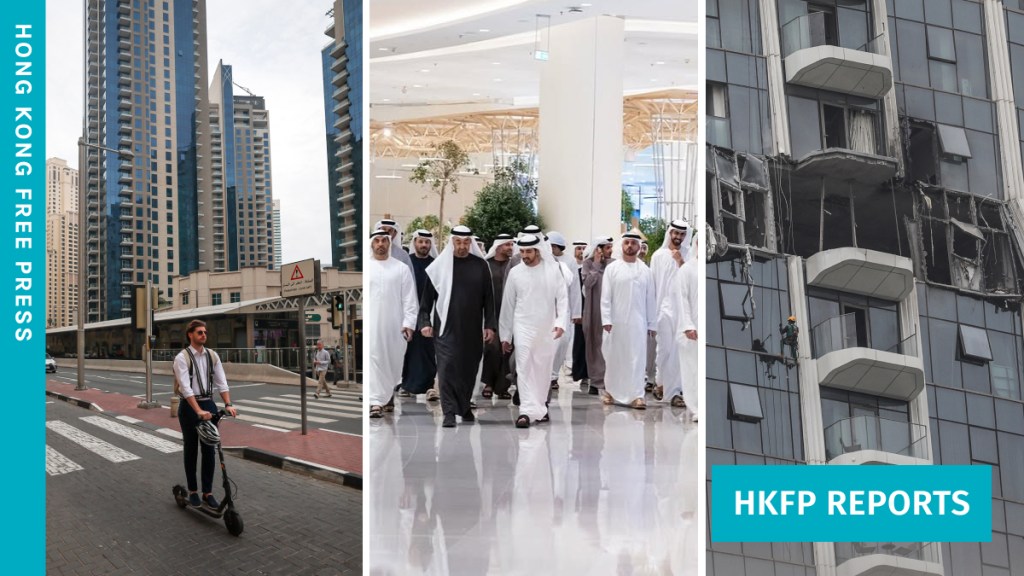
As the United Arab Emirates (UAE) and other Gulf states were targeted by Iranian airstrikes, Hongkonger Oi Chau joined a chorus of other expats saying it was “business as usual” in Dubai. Dubai’s leaders make a public appearance on the evening of March 2, 2026. Photo: Dubai Media Office, via Instagram. She was convinced after seeing images of UAE President Sheikh Mohamed bin Zayed Al Nahyan and Dubai Crown Prince Sheikh Hamdan bin Mohammed bin Rashid Al Maktoum, who also serves as defence minister, strolling around Dubai Mall on March 2 – two days after the US-Israeli attacks on Iran triggered a military conflict in the Middle East. Four weeks later, on Monday, the crown prince, Sheikh Hamdan, made another visit to the same mall – this time with Finance Minister Sheikh Maktoum bin Mohammed bin Rashid Al Maktoum. It was “as if nothing happened, as if it was business as usual,” Chau told HKFP.
The UAE, a regional economic superpower that hosts US military assets, seems to bear the brunt of Iranian strikes. As of Wednesday, UAE air defences had intercepted 438 ballistic missiles, 19 cruise missiles, and 2,012 drones launched by Tehran. The Ministry of Defence said 12 people – nine of whom were foreign nationals – had been killed and 190 others injured. Last month, the Hong Kong government raised travel alerts for countries in the Middle East, including the UAE and Saudi Arabia. It said that as of March 23, about 590 of the 830 Hong Kong residents who sent enquiries to the Immigration Department had left the region, while 240 remained behind in the UAE, Qatar and Saudi Arabia.
Despite growing uncertainty over the war in the Middle East, Chau was among Hongkongers – long accustomed to their home city’s insularity from armed conflicts – who have chosen to stay put. Hong Kong to Dubai Chau recalled hearing the initial strikes on February 28 from her flat at the Dubai Marina district. She lives a 30-minute drive away from the Port of Jebel Ali, a major shipping hub. “At first, I was scared,” Chau said. “But then I saw the images of the leaders going about their normal lives, and I thought, ‘Maybe it’s not that bad.’”
For Chau, the decision to stay in Dubai was not just about personal safety but also about the stability of her work and life. She works in marketing for a multinational company based in the UAE, and her job requires her to be present. “If I leave, I might lose my job,” she explained. “And I can’t afford to be out of work right now.” Her family, however, is split. Her parents have chosen to leave the region and return to Hong Kong, while her younger brother has decided to stay in Dubai with her.
The UAE’s government has played a significant role in reassuring expats like Chau that life in the country is continuing as normal. Sheikh Mohamed bin Zayed Al Nahyan’s public appearances and the frequent visits of other high-profile officials to public spaces have been deliberate efforts to show that the country is not affected by the conflict. “The UAE government is very good at managing a crisis and keeping people calm,” Chau said. “They want to make sure that the economy stays stable, and that’s why they’re doing this.”
The UAE’s economy, heavily reliant on sectors like tourism, aviation, and finance, has been hit hard by the conflict. However, the government has taken steps to support both locals and expats. The Ministry of Economy has announced measures to support small and medium-sized enterprises, while the Ministry of Labour has provided financial assistance to those affected by the conflict.
For Hongkongers in the Middle East, the decision to stay or leave is often influenced by their personal circumstances and the perceived level of safety. While many have chosen to leave, others like Chau remain, convinced that the situation is under control. “I’m not saying it’s completely safe,” Chau admitted. “But I think the UAE government is doing everything they can to protect us. And as long as that’s the case, I’ll stay.”
The conflict in the Middle East has brought to light the complexities of life as an expat in a region that is not their home. For Hongkongers, who have long been known for their pragmatic approach to life, the decision to stay in Dubai despite the conflict reflects a sense of resilience and adaptability. As the situation continues to evolve, it remains to be seen how many will choose to stay, and how many will eventually leave. But for now, at least, life in Dubai goes on – business as usual.









