
Home ScienceBBC Inside Science...
ScienceтнР Featured

BBC Inside Science

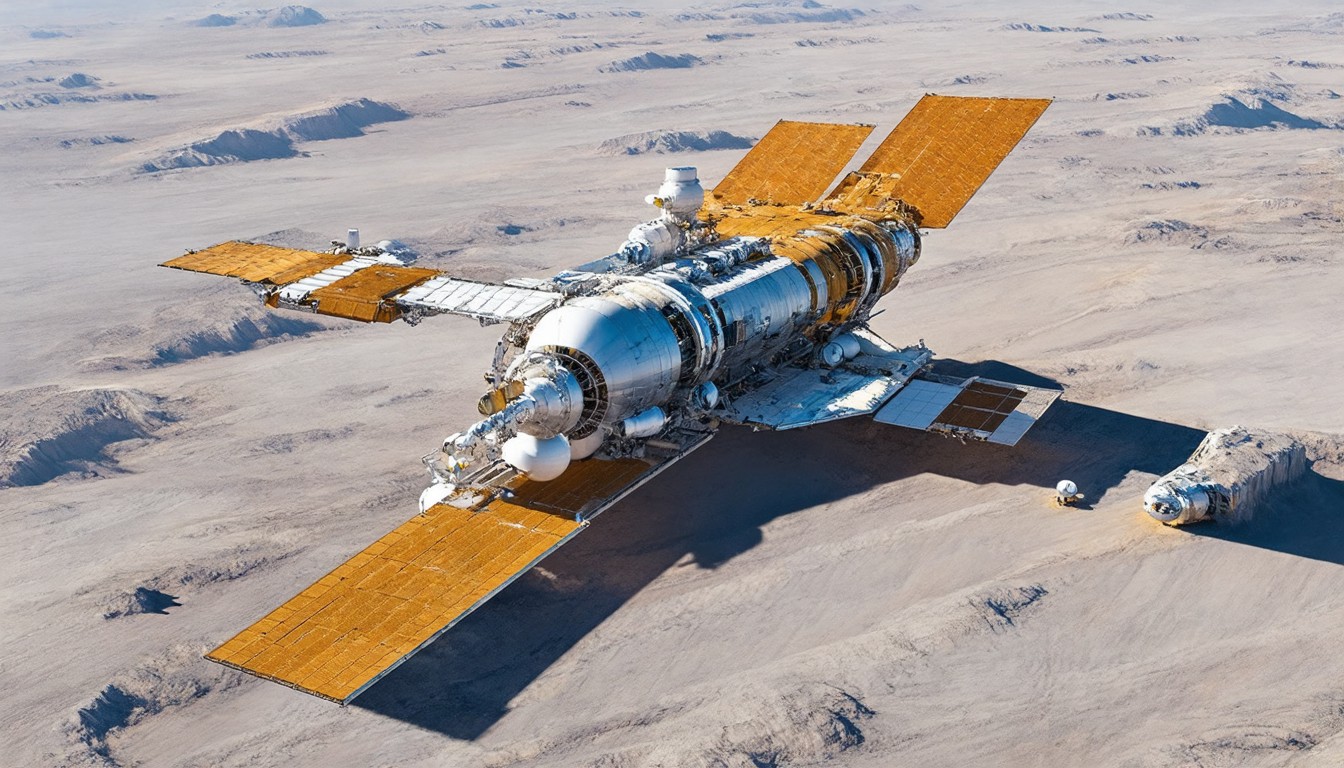
A nuclear-powered spacecraft promises deeper and more explorative space travel.
7 April 2026 at 09:31 am
1 views
BBC Inside Science

In a groundbreaking development that could revolutionize space exploration, scientists and engineers are working on a nuclear-powered spacecraft designed to propel humanity further into the cosmos. This ambitious project, spearheaded by a consortium of international research institutions and space agencies, aims to overcome the limitations of traditional propulsion systems, enabling missions to distant celestial bodies that were previously unreachable.

The concept of nuclear-powered spacecraft is not entirely new. Since the early days of space exploration, scientists have recognized the potential of nuclear energy to provide the immense thrust required for interstellar travel. However, the technical challenges and safety concerns associated with nuclear technology have historically hindered the development of such systems. Recent advancements in nuclear reactor design, materials science, and propulsion technology have now made this vision a reality.

The proposed spacecraft will utilize a nuclear thermal rocket (NTR) as its primary propulsion system. An NTR operates by heating a propellant, such as liquid hydrogen, using heat generated from a nuclear reactor. The resulting high-speed exhaust provides the necessary thrust to propel the spacecraft. Compared to chemical rockets, which rely on the combustion of fuel, NTRs offer significantly greater specific impulse, meaning they can achieve greater velocities with less propellant. This efficiency is crucial for long-duration missions, as it reduces the amount of fuel required and extends the spacecraft's operational lifespan.

One of the most significant advantages of nuclear-powered spacecraft is their ability to undertake deep-space exploration. Missions to the outer planets, such as Neptune and Uranus, currently take years to complete due to the limitations of chemical propulsion. With a nuclear-powered spacecraft, these missions could be significantly shortened, allowing for more frequent and comprehensive scientific investigations. Furthermore, the technology could pave the way for manned missions to Mars, reducing the travel time from the current six-month journey to a more manageable duration.

Beyond the solar system, nuclear-powered spacecraft could enable humanity to embark on interstellar missions. The Alpha Centauri star system, located just 4.37 light-years away, has long been a target for ambitious space exploration plans. A nuclear-powered spacecraft could potentially reach this system within a human lifetime, opening up the possibility of first contact with extraterrestrial civilizations or the exploration of potentially habitable worlds.

However, the development of a nuclear-powered spacecraft is not without its challenges. Safety remains a paramount concern, as the use of nuclear technology on board a spacecraft introduces new risks. Engineers must ensure that the reactor design is robust enough to withstand the extreme conditions of space, including radiation exposure and potential launch vibrations. Additionally, the disposal of radioactive waste generated during the mission must be carefully managed to prevent contamination of celestial bodies or, in the case of an accident, Earth's environment.

Collaboration between international space agencies, such as NASA, ESA, and Roscosmos, is crucial to the success of this project. These organizations are pooling their resources and expertise to address the technical and safety challenges associated with nuclear-powered spacecraft. Public-private partnerships are also playing a vital role, with companies such as Blue Origin and X Prize Foundation investing in research and development of advanced propulsion systems.

The potential benefits of a nuclear-powered spacecraft far outweigh the challenges. By unlocking the frontiers of deep space exploration, this technology could lead to groundbreaking scientific discoveries, advancements in space technology, and even the realization of humanity's age-old dream of interstellar travel. As the project progresses, the international scientific community is closely monitoring its development, eager to witness the dawn of a new era in space exploration.

In conclusion, the nuclear-powered spacecraft represents a significant leap forward in our quest to understand the universe. With its unparalleled propulsion capabilities, this innovative technology promises to expand the boundaries of human knowledge and enable missions that were once considered impossible. As the scientific community continues to refine the design and address safety concerns, the prospects for deeper and more explorative space travel have never been more exciting. The future of space exploration is poised on the brink of a transformative shift, and the nuclear-powered spacecraft is at the forefront of this revolutionary change.


Source: BBC News
ЁЯУ░ Related News
The largest orbital compute cluster is open for business | TechCrunch
Kepler Communications is flying 40 GPUs in Earth orbit. And its latest customer is Sophia Space.
14 Apr
тАШMideast conflict poses risks to Philippines growthтАЩ
The Philippine economy is expected to grow at a faster pace of 5.3 percent this year from last year’s 4.4 percent but the ongoing Middle East conflict is seen to pose risks, according to the Association of Southeast Asian Nations Plus 3 Macroeconomic Research Office.
7 Apr
AFBI welcomes DUP representatives to its research farm at Hillsborough
The Agri-Food and Biosciences Institute (AFBI) welcomed a number of DUP representatives to its research farm at Hillsborough on Friday.
7 Apr
A simple way to get more value from metrics
We spent one day 1 building a system that immediately found a mid 7 figure optimization (which ended up shipping). In the first year, we shipped mid 8 figures per year worth of cost savings as a result. The key feature this system introduces is the ability to query metrics data across all hosts and all services and over any period of time (since inception), so we've called it LongTermMetrics (LTM) internally since I like boring, descriptive, names. This got started when I was looking for a starter project that would both help me understand the Twitter infra stack and also have some easily quantifiable value. Andy Wilcox suggested looking at JVM survivor space utilization for some large services. If you're not familiar with what survivor space is, you can think of it as a configurable, fixed-size buffer, in the JVM (at least if you use the GC algorithm that's default at Twitter). At the time, if you looked at a random large services, you'd usually find that either: The buffer was too small, resulting in poor performance, sometimes catastrophically poor when under high load. The buffer was too large, resulting in wasted memory, i.e., wasted money. But instead of looking at random services, there's no fundamental reason that we shouldn't be able to query all services and get a list of which services have room for improvement in their configuration, sorted by performance degradation or cost savings. And if we write that query for JVM survivor space, this also
7 Apr
Accelerating Mathematical and Scientific Discovery with Gemini Deep Think
Research papers point to the growing impact of Deep Think across fields
7 Apr
Gemini 3 Deep Think: Advancing science, research and engineering
Our most specialized reasoning mode is now updated to solve modern science, research and engineering challenges.
7 Apr
Context Engineering for Coding Agents
The number of options we have to configure and enrich a coding agent’s context has exploded over the past few months. Claude Code is leading the charge with innovations in this space, but other coding assistants are quickly following suit. Powerful context engineering is becoming a huge part of the developer experience of these tools. Birgitta Böckeler explains the current state of context configuration features, using Claude Code as an example. moreтАж
7 Apr
What does less protein and nitrogen mean for methane?
Does feeding less protein to cows over a longer period not only reduce nitrogen losses, but also affect methane emissions? Researchers at Wageningen University & Research (WUR) investigated this in a multi-year study with dairy cows, funded by the Vereniging Diervoederonderzoek Nederland (VDN), the Dutch Ministry of Agriculture, Fisheries, Food Security and Nature (LVVN), and […] The post What does less protein and nitrogen mean for methane? appeared first on Agriland.ie .
7 Apr
SecondтАЩs Bark Boasts New era of Bitcoin Payments, drawing in former Blockstream developers
Bitcoin Magazine SecondтАЩs Bark Boasts New era of Bitcoin Payments, drawing in former Blockstream developers Second, the Bitcoin development lab founded by ex-Blockstream executives including CEO Steven Roose and CTO Erik De Smedt, has unveiled Bark тАФ its custom Ark protocol implementation promising self-custodial payments that are faster and cheaper than Lightning channels. This post SecondтАЩs Bark Boasts New era of Bitcoin Payments, drawing in former Blockstream developers first appeared on Bitcoin Magazine and is written by Juan Galt .
7 Apr
'Morale boost': Nasa carries out Moon mission during tough year for science
HOUSTON — As the four Artemis astronauts approached a high point of their lunar mission -- getting slung around the far side of the Moon -- National Aeronautics and Space Administration (Nasa) staffers crowded into Houston's famed mission control room Monday for a team photo.
7 Apr






