
Are we in the foothills of World War 3?
The coalitions are hardening, and the weapons are being deployed.
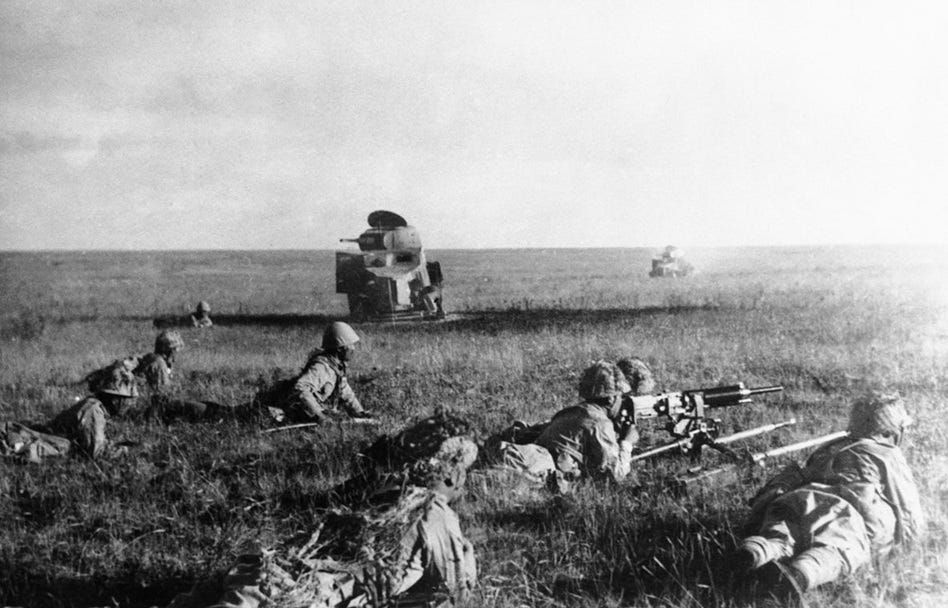
In recent years, the world has witnessed a series of geopolitical tensions and conflicts that have raised concerns about the possibility of a third world war. While no such conflict has yet erupted, the current landscape of international relations is marked by hardening coalitions and the deployment of advanced weaponry, reminiscent of the foothills leading up to World War 2.
The Battle of Khalkhin Gol in 1939, fought between Imperial Japan and the Soviet Union, serves as a historical example of these "foothills." This four-month conflict, which was actually the main phase of an undeclared war beginning in 1935, demonstrated that the groundwork for major global conflicts can be laid years before the official outbreak of hostilities. The Soviet Union's victory, achieved through superior tank usage, foreshadowed the eventual outcome of World War 2. Similarly, today's geopolitical landscape is characterized by a series of conflicts and tensions that could potentially escalate into a full-scale war.
One such example is the Syrian Civil War, during which the U.S. and Russia began testing their new military hardware against each other. In 2017, Russian and U.S. troops even clashed in the Syrian desert, marking the first direct military confrontation between the two superpowers since the Cold War. This early 21st-century conflict highlighted the shifting dynamics of global alliances and the resurgence of great-power rivalries.
The Russian invasion of Ukraine in 2022 marked a significant turning point. It inaugurated a new era of great-power territorial conquest, accelerated the hardening of global alliance systems, and prompted Europe to reconsider its military posture. The conflict has drawn NATO member states closer together and has seen countries like Poland and Finland pursue membership in the alliance, further solidifying the divide between the Western bloc and Russia.
More recently, the Iran War has added another layer of complexity to the global security situation. The U.S. and Israel initiated the conflict by launching attacks on Iranian targets, decapitating much of its leadership and achieving air supremacy. In response, Iran has launched missile and drone attacks on multiple Middle Eastern nations, prompting some of these countries to threaten joining the war on the side of the U.S. and Israel. While the immediate outcome of this conflict remains uncertain, it has underscored the fragility of regional stability and the potential for localized conflicts to spiral into a broader war.
Militarily, the U.S. and Israel have had significant successes in the Iran War, degrading Iran's missile and drone capabilities. However, this does not necessarily guarantee the collapse of the Iranian regime. Protests and internal dissent may persist, and the conflict could evolve into a prolonged stalemate.
Looking at the historical parallels, it is clear that the world today is not entirely unprepared for the possibility of a third world war. The hardening of alliances, the deployment of advanced weaponry, and the recurring conflicts between major powers all point to a precarious global situation. While it remains uncertain whether these tensions will escalate into a full-scale war, the foothills of such a conflict are undeniably present.
In conclusion, the current geopolitical landscape is marked by a series of tensions and conflicts that echo the conditions leading up to World War 2. While no such global conflagration has yet occurred, the hardening of alliances, the deployment of advanced weaponry, and the recurring clashes between major powers highlight the potential for escalation. As history has shown, the foothills of a world war can be a deceptively calm prelude to a far more devastating conflict. It is therefore crucial for world leaders to exercise caution and diplomacy in navigating these precarious times, striving to resolve disputes through dialogue and cooperation rather than resorting to military force.








