
Are we in the foothills of World War 3?
The coalitions are hardening, and the weapons are being deployed.
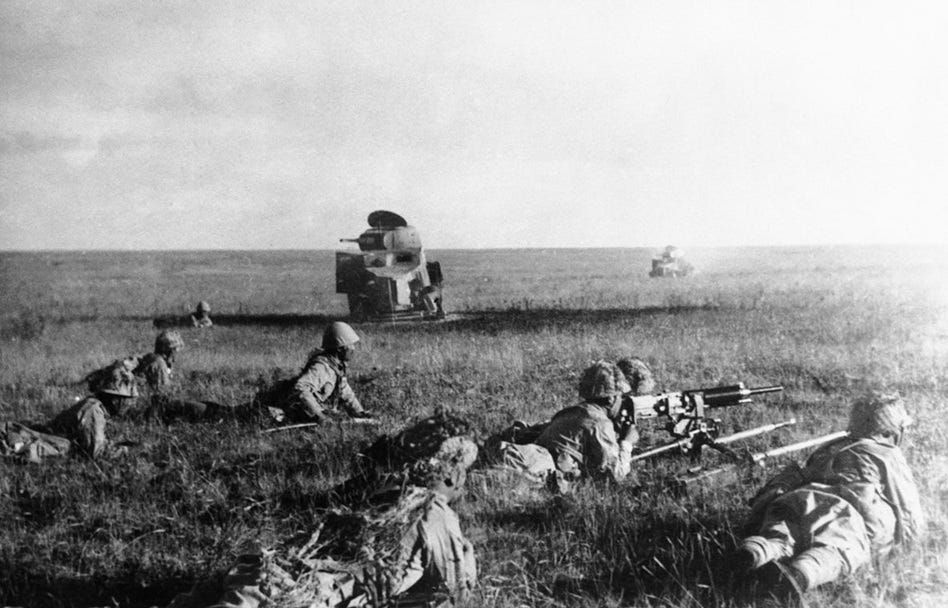
In recent years, the world has witnessed a series of geopolitical tensions and conflicts that have raised concerns about the possibility of a third world war. While no such conflict has yet erupted, the current landscape of international relations is marked by hardening coalitions and the deployment of advanced weaponry, reminiscent of the foothills leading up to World War 2.
The Battle of Khalkhin Gol in 1939, fought between Imperial Japan and the Soviet Union, serves as a historical example of these "foothills." This four-month conflict, which was actually the main phase of an undeclared war beginning in 1935, demonstrated that the groundwork for major global conflicts can be laid years before the official outbreak of hostilities. The Soviet Union's victory, achieved through superior tank usage, foreshadowed the eventual outcome of World War 2. Similarly, today's geopolitical situation is characterized by ongoing tensions and proxy wars that could potentially escalate into a full-scale conflict.
One such proxy war is the Syrian Civil War, where the United States and Russia have tested their new military hardware against each other. In 2017, Russian and U.S. troops even clashed directly in the Syrian desert, marking a significant escalation in the rivalry between these two superpowers. The Russian invasion of Ukraine in 2022 marked a turning point, as it inaugurated a new era of great-power territorial conquest, began to harden global alliance systems, and prompted Europe to accelerate its remilitarization efforts.
The most recent development in this pattern of escalating tensions is the Iran War, initiated by the United States and Israel with a series of attacks targeting Iranian leadership. The Iranian response has been unconventional, with missile and drone attacks on multiple Arab nations in the Middle East, leading some of these nations to threaten joining the conflict on the side of the U.S. and Israel. While the immediate outcome of this conflict remains uncertain, with no decisive results expected in the short term, the military actions taken by the U.S. and Israel have generally been successful in assassinating Iranian leadership, achieving air supremacy, and degrading Iran's missile and drone strike capabilities.
However, the likelihood of the Iranian regime collapsing as a result of these actions is low. Protests in Iran have been widespread and persistent, but they have not yet resulted in the overthrow of the government. This situation highlights the complexities of modern warfare, where military success does not always equate to political victory.
The current geopolitical landscape is marked by a complex web of alliances and rivalries, with major powers engaging in a global arms race and deploying advanced weaponry. While the risk of a full-scale world war remains uncertain, the historical parallels to the foothills of World War 2 are undeniable. As tensions continue to rise and alliances harden, the potential for a catastrophic conflict cannot be entirely ruled out. The key question now is whether world leaders can navigate these challenges without pushing the global community into the abyss of another world war.








