
Home TechnologyAI Isn’t Coming For Your Job: Automation Is...
Technology⭐ Featured

AI Isn’t Coming For Your Job: Automation Is

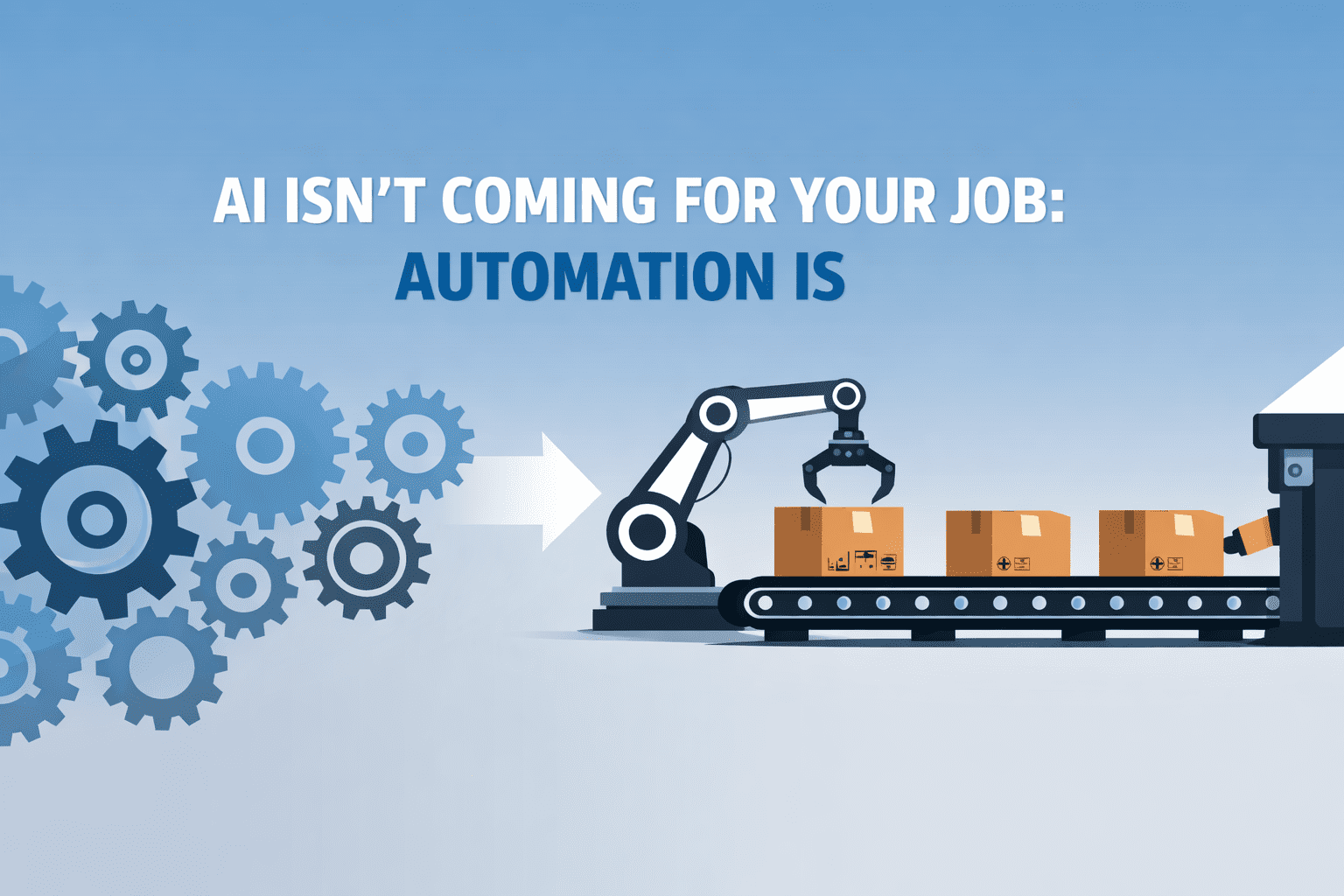
But here's what nobody's actually saying out loud: the threat everyone keeps attributing to AI belongs more specifically to automation.
6 April 2026 at 08:04 pm
1 views
AI Isn’t Coming For Your Job: Automation Is

In recent years, the looming threat of artificial intelligence (AI) taking over jobs has become a common topic of conversation. From the boardroom to the living room, people worry about whether their roles will be replaced by machines. However, there's an important nuance often overlooked in these discussions: the threat to jobs isn't necessarily coming from AI itself, but rather from automation.

Automation, the process of performing tasks without human intervention, has been around for decades. It's not a new concept, but its rapid advancement in recent years has made it a significant concern for workers. While AI is often highlighted as the primary culprit, automation encompasses a broader range of technologies, including robotics, computer systems, and even simple software programs that can perform repetitive tasks more efficiently than humans.

One of the key differences between AI and automation is that AI involves machine learning and the ability to make decisions based on data. While AI can certainly automate tasks, it's not the only force driving job displacement. In fact, many current automation efforts rely on simpler, rule-based systems that don't require the advanced capabilities of AI. These systems can still significantly impact employment by streamlining processes and reducing the need for human labor.

For example, consider the manufacturing industry, where automation has been prevalent for years. Robots on assembly lines have long replaced human workers in tasks like welding and painting. While AI can enhance these systems by optimizing production schedules or detecting defects, the core automation is often driven by programmed robots and sensors, not machine learning algorithms.

Similarly, in customer service, chatbots and automated response systems are common. These tools use pre-programmed scripts to handle inquiries, freeing up human agents for more complex tasks. Again, while AI can improve these systems by understanding natural language and learning from interactions, the basic automation is achieved through rule-based systems.

The distinction between AI and automation becomes even clearer when looking at industries where AI hasn't yet made significant inroads. For instance, in many administrative and clerical jobs, automation through software like document management systems or payroll applications has already reduced the need for human workers. These tasks don't require the cognitive abilities of AI but are still automated to increase efficiency and reduce costs.

This shift towards automation isn't limited to blue-collar or low-skilled jobs. Even in white-collar fields, automation is on the rise. Legal document review, financial analysis, and even journalism have seen automation take on tasks traditionally performed by humans. While AI can enhance these processes, the core automation often relies on existing technologies that don't require advanced machine learning.

The focus on AI as the primary threat to jobs can be misleading. It's important to recognize that automation, in its many forms, is the broader force at play. As technology continues to advance, it's not just AI that will drive job displacement, but the overall trend towards automating tasks that were once done by humans.

This reality has significant implications for workers and policymakers. As automation becomes more prevalent, it's crucial to address the potential economic and social impacts. This includes reskilling programs to help workers adapt to new roles, as well as policies to ensure that the benefits of automation are shared equitably.

In conclusion, while AI is often highlighted as the primary threat to jobs, it's essential to recognize that automation—a broader and more established technology—is the real force behind job displacement. Understanding this distinction can help inform strategies for adapting to a world where machines handle an increasing number of tasks, and ensuring that the transition to a more automated workforce is managed thoughtfully and equitably.


Source: KDnuggets
📰 Related News
Ekaya Banaras Founder Palak Shah’s ₹40 Lakh Billboard Mistake Became a Masterclass in Startup Marketing
Ekaya Banaras founder Palak Shah recently opened up about one of the most expensive mistakes she made while building her luxury textile brand. During the early years of the company, Shah rented a premium billboard near Delhi’s DLF Emporio to increase brand visibility. However, after forgetting to cancel the campaign, the hoarding reportedly continued running for months — resulting in losses of nearly ₹40 lakh. The incident has now become a viral example of how small operational oversights can turn into costly business lessons for startups and entrepreneurs.
28 May
Betting On AI: Jensen Huang And NVIDIA’s Rise To The Top
Before AI was inevitable, it was a gamble—and Jensen Huang went all in.
14 Apr
Red Hat OpenShift sandboxed containers 1.12 and Red Hat build of Trustee 1.1 bring confidential computing to bare metal and AI workloads
Red Hat is excited to announce the release of Red Hat OpenShift sandboxed containers 1.12 and Red Hat build of Trustee 1.1, marking a major leap forward in our confidential computing journey. These releases graduate confidential containers on bare metal from …
14 Apr
Large AI firms hoovering maximum funding, not enough for smaller startups: Y Combinator’s Ankit Gupta
YC Startup School: India’s talent pool across colleges and universities are key for building next-gen startups, which is what YC is looking to tap into. It wants to target entrepreneurs building for global markets, focussed on fintech, consumer, B2B, and ecom…
14 Apr
TSMC likely to book fourth straight quarter of record profit on insatiable AI demand
TSMC-RESULTS/ (PREVIEW, PIX):PREVIEW-TSMC likely to book fourth straight quarter of record profit on insatiable AI demand
14 Apr
TSMC likely to book fourth straight quarter of record profit on insatiable AI demand
Any profit result ‌above T$505.7 billion would mark the company's highest-ever quarterly net income ​and its ninth consecutive quarter of profit growth
14 Apr
TSMC likely to book fourth straight quarter of record profit on insatiable AI demand
On Thursday, ​TSMC is expected to report a net profit of $17.1 billion for the quarter, according to an LSEG SmartEstimate compiled from 19 analysts. The war in the Middle East threatens to disrupt the supply of production materials for semiconductors such as…
14 Apr
If we can’t kick the habit, how do we manage AI’s energy needs?
One can only hope that OpenAI’s Sam Altman was joking when he sought to justify the immense energy consumption of artificial intelligence
14 Apr
What caused Nvidia Blackwell GPU prices to spike? #tech
Blackwell GPU hourly “rent” surges on agentic AI demand A compute pricing index tracking hourly costs for Nvidia Blackwell GPUs shows a sharp climb: hourly rental hit $4.08 , up 48% from $2.75 just two months earlier. The reported driver is rising demand tied…
14 Apr
Anthropic Releases Claude Mythos Preview with Cybersecurity Capabilities but Withholds Public Access
Anthropic has introduced Claude Mythos Preview, its most advanced AI model, improving significantly in reasoning, coding, and cybersecurity. Unlike previous releases, it will not be publicly available. Access is limited to a consortium of tech companies throu…
14 Apr







